
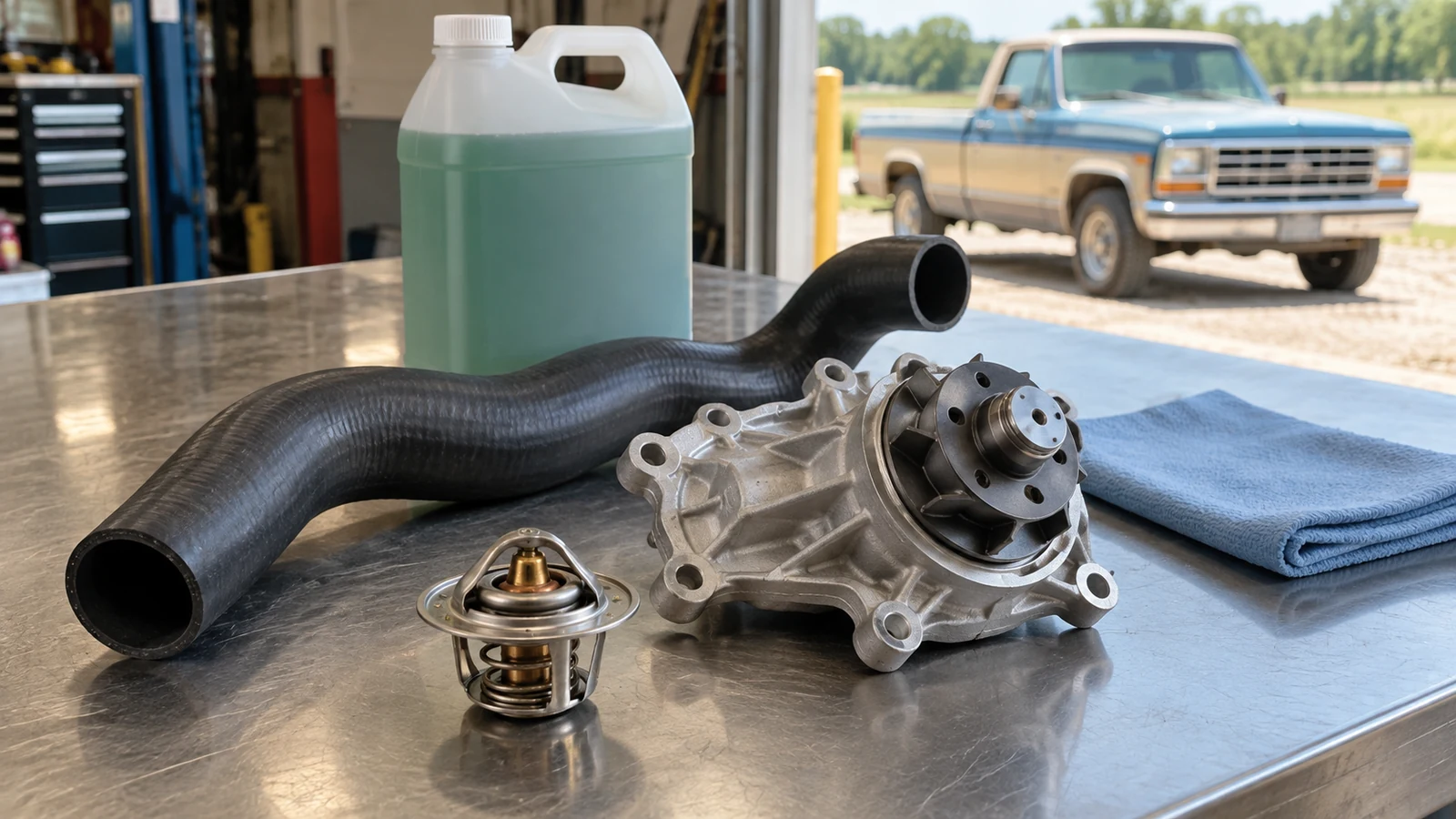
July in Alvord is when a cooling system stops being an abstraction. The hay is moving, the stock tanks need checking, and the trucks that do that work are idling in the sun with a loaded trailer behind them and a temperature gauge that nobody looked at in April. Alvord sits about 20 miles north of Decatur, roughly 20 to 25 minutes away on US-287 and US-380, and it is farm and ranch country - which means the vehicles here are often older domestic trucks with real mileage on them, doing short trips at low speed on gravel and dirt, then a long pull down the highway with weight behind them. That combination is exactly what finds a weak hose, a tired thermostat, or a fan clutch that quit working two summers ago. This is a guide to catching those problems on your own time instead of on the shoulder of the highway.
Why Summer Heat Is Harder on Alvord Farm and Ranch Trucks
A cooling system is sized for a design load, and most factory design loads assume a vehicle that is moving, with highway airflow through the radiator doing much of the work. Farm and ranch use inverts that. A truck feeding round bales spends long stretches at idle or at five miles an hour in low gear, making heat with almost no air moving through the core, and a truck hauling a gooseneck up a grade on US-287 in triple-digit heat wants peak capacity at the moment ambient air can absorb the least.
Then there is dust. Agricultural operations around Alvord generate a lot of it, and radiator and condenser fins collect chaff, seed fluff and fine grit. A radiator that looks clean from the front can be packed solid between the core and the air conditioning condenser. We see this pattern constantly with farm and ranch customers from the Alvord area: the part they eventually need is the symptom, and blocked airflow was the cause.
Age compounds it. Rubber fails on a curve, and heat cycling accelerates that curve, so a hose that survived eight Texas summers is not the same hose it was even if it looks fine. Additive packages deplete, pump seals harden, thermostat elements get lazy, and tensioners lose spring rate. None of that announces itself, and all of it shows up in July.
How the Cooling System Actually Works
Understanding the loop makes diagnosis easier. The water pump pushes coolant through the block and heads, where it absorbs combustion heat, and out at the thermostat housing. Cold, the thermostat stays closed and coolant recirculates through a bypass so the engine warms quickly. Once its wax element reaches rated temperature it opens, coolant flows to the radiator where airflow pulls heat out of the fins, and the lower hose returns it to the pump.
Two side circuits matter: the heater core, a small radiator in the cab fed by the heater hoses, and the pressure cap, which raises the boiling point - a failed cap alone can cause boil-over.
The airflow side has its own hardware. Older domestic trucks use a belt-driven fan with a fan clutch and a shroud that forces air through the core rather than around it, while newer designs use electric fans with relays and sensors. If the shroud is cracked out or missing, cooling at idle falls off badly - a common finding on a work truck that has had its radiator out.
Hoses: Catching a Weeper Before It Strands You
Hoses are the easiest failure to prevent and a common reason a truck gets left in a pasture.
Inspect radiator hoses only after the engine and coolant are fully cold, with the engine off and the key secured. Never open a hot pressure cap. Keep clear of electric fans, which may start unexpectedly; follow the manufacturer's isolation instructions before reaching into the fan area. From a safe position, look for swelling, cracking, abrasion, and dried coolant residue, and have suspect parts assessed.
Check the lower radiator hose too, which people skip because it is harder to reach. Lower hoses see suction from the pump and many carry an internal wire coil to keep from collapsing. When that coil rusts and the rubber softens, the hose can collapse at high rpm and starve the pump - an overheat that only appears under load. Inspect the heater hoses at the firewall and the bypass hoses as well; on high-mileage engines they are often original.
Abrasion is the other killer on farm trucks. A hose rubbing a bracket, shroud or wiring loom wears through the cover and then the reinforcement, so fix the cause along with the hose. Radiator, heater and bypass hoses are core counter stock, and Gates is one of the brands on our shelves for this work. Bring the old hose or your year, make, model and engine size so we can match the shape - molded hoses are engine-specific, and a generic flex hose bent into a tight radius will kink.
Replace clamps along with hoses, since old worm-gear clamps lose tension and cut into new rubber. Then purge the air on refill: a pocket at the thermostat keeps it from sensing real coolant temperature, which is the classic cause of overheating right after a repair.
Thermostats, Water Pumps, and What Their Symptoms Look Like
A thermostat has two failure modes that present in opposite ways. Stuck closed means rapid overheating with an upper hose that stays cool while the gauge climbs. Stuck open or lazy means an engine that runs cool, takes forever to warm up, and may set a code for insufficient coolant temperature - which is not harmless, since it hurts fuel economy and lets condensation and fuel dilution build in the crankcase.
Match the rated temperature to what the engine was designed for. A colder thermostat does not add cooling capacity; it only delays when the system starts shedding heat and masks the real fault. Fix the cause instead.
Water pumps usually warn you. Listen for a growl or rumble from the front of the engine that changes with rpm - that is a failing bearing. Look for coolant staining, dried residue, or a drip at the pump's weep hole, which exists specifically to let a failing seal leak externally rather than into the bearing. With the belt off, grab the pump pulley and check for side-to-side play or roughness as you turn it. On engines where the water pump lives behind a timing cover, plan the job with the timing components in the same visit, because doing it twice doubles the work.
Because farm and ranch trucks in the Alvord area are frequently older domestic three-quarter-ton and one-ton pickups, the parts you need often sit on the line between light-duty and heavy-duty applications. Our heavy-duty truck parts side of the counter covers a lot of that ground, and for everything else our general auto parts selection is where the hoses, thermostats, gaskets, sensors and pumps live. If you are not sure which category your truck falls into, call and tell us the engine and the gross weight rating and we will look at both.
Fan Clutches, Electric Fans, and Idle Cooling
Here is the most useful diagnostic clue in summer cooling work: does the truck overheat at idle and slow work but stay normal on the highway, or the reverse?
Overheating at low speed and idle, with normal highway temperatures, points at airflow. That means a failed fan clutch, an inoperative electric fan, a missing or broken shroud, or a radiator blocked with debris. A thermal fan clutch that has lost its fluid lets the fan freewheel; the truck goes unusually quiet at startup because the fan no longer roars, and the fan spins by hand far too easily. Silicone fluid leaking from the clutch body leaves an oily film on the shroud.
Overheating on the highway or under load with fine idle temperatures points at coolant flow: thermostat, water pump, a collapsed lower hose, a plugged core, or a head gasket pushing combustion gas into the coolant. Overheating in both conditions usually means low coolant, a bad cap, air in the system, or a scaled-up radiator.
On electric-fan vehicles, check fuses, the relay, the coolant temperature sensor and the connector before condemning the fan. On belt-driven setups, inspect the blades - a cracked plastic fan on a truck two decades into service is a hazard at speed.
Belts, Tensioners, and Pulleys
The serpentine belt drives the water pump on most engines, so belt condition is cooling system condition. Modern EPDM belts wear thin rather than cracking, losing rib material until they slip without ever looking bad. Look for a glazed surface, rounded rib edges, or material missing from the bottom of a rib.
A squeal, chirp, or rumble is a clue rather than a reliable parts diagnosis. Have alignment, tension, and bearings checked under the prescribed shutdown procedure. Never run an engine with its accessory belt removed as a noise test; the belt may drive the water pump and other essential components.
Replace the tensioner and idler pulleys with the belt when they are original and high mileage. Spin each with the belt off; grit, roughness or side play means it is done, and a tensioner that has lost spring rate will let a new belt slip on the first hot day with the air conditioning loaded up. Keep a spare belt behind the seat on any truck that works out of cell range. Our brands page lists what we carry, and belts, tensioners and hose lines from those makers are the everyday stock at the counter.
Coolant Types and Why Mixing Them Causes Problems
Coolant is not just antifreeze; it is a corrosion inhibitor package suspended in glycol and water, and different chemistries exist because engines use different metals and sealing materials.
The broad families are conventional green inhibited with silicates and phosphates, extended-life organic acid formulations, hybrid organic acid types, and the nitrited heavy-duty coolants used in many diesel applications where cylinder liner protection matters. The important practical point is that these packages are not designed to work together. Mixing incompatible chemistries can drop inhibitors out of suspension as a gel or sludge, which plugs radiator tubes and heater cores, or can strip the protective film off a component that was relying on it. Clearing sludge out of a radiator is far more work than reading the label was.
Use the exact coolant approval and dilution specified for the engine; color alone is not a specification. If the existing fluid is unknown, have a qualified shop determine the correct service procedure rather than mixing by guesswork. Do not keep driving an overheating truck to reach home. Stop safely, shut it down, let it cool without opening the hot cap, and arrange assistance if temperature, leakage, or warning lights remain abnormal.
Test rather than guess. A refractometer or test strip tells you freeze point and, on some strips, inhibitor condition. Coolant that looks rusty, has a film on top, or smells burnt has been in there too long. Tell us the engine and the coolant type on the cap, and we will point you to what matches rather than what is nearest.
High-Mileage Older Domestic Trucks: A Realistic Plan
The Alvord page on our site names farm and ranch customers and older domestic trucks specifically, and that is a fair description of what rolls in from that direction. On a truck past 150,000 miles that has never had cooling work, treat the system as a set rather than a list of individual failures. When the water pump comes off, the thermostat, gasket, hoses, clamps, belt, tensioner and coolant are all right there, and doing that teardown twice in one summer is a wasted Saturday.
There is also an order of operations that saves effort. Clean the radiator and condenser fins first, low pressure from the engine side out so debris goes back the way it came. Then pressure test, or at minimum hunt for residue at every joint after a hot run. Then replace what you found. Many "the radiator is shot" conclusions turn out to be a plugged fin pack and a dead fan clutch.
Carry the correct premixed coolant, a flashlight, and useful identification information, but do not treat spare fluid as permission to drive through an overheat. Never pour cold liquid into a hot system or open its cap under pressure. A roadside inspection should not put anyone beside traffic or beneath an unsupported truck.
Getting the Right Parts from Alvord Without Two Trips
The drive from Alvord down to our counter at 803 W Main St in Decatur is short by ranch standards - about 20 miles, 20 to 25 minutes on US-287 and US-380 - but it is still a round trip you do not want to make twice in one afternoon. A phone call first is the whole trick.
When you call, have four things ready: year, make and model; engine size, and say so if it is a diesel; the part name or number; and whether you need it the same day. That last one changes the answer. If it is on the shelf we will tell you, and if it has to be ordered, most special orders arrive within one to two business days - which lets you plan the job instead of leaving a truck on jack stands.
Bring the old part when you can. A hose, a thermostat, a pulley or a fan clutch in hand removes the guesswork that catalog variations introduce, and it is faster than describing it. Note our hours before you head down: Monday through Friday 8:00 AM to 5:30 PM, Saturday 8:00 AM to 1:00 PM, and closed Sunday. The counter is not staffed outside those hours, so a Saturday afternoon project needs its parts bought Saturday morning. To check stock or ask what your engine takes, call (940) 627-2350.
We are a parts counter. We do not repair vehicles and we do not come out to you - we stock the parts, help you identify the right one, and get you back to the work. We have been locally owned and operated since 1985, which mostly means we have had this conversation about this engine before.
Beyond Alvord: The Rest of Wise County Runs the Same Playbook
Cooling work does not respect city limits. The same hoses and fan clutches show up on trucks from Chico, Paradise, Bridgeport and Bowie, and the same three questions - does it overheat at idle, under load, or both - narrow it down every time. If you want the details for your own town, including drive routes and the customer types we see from each direction, our areas we serve overview covers the county, and the Alvord page has the specifics for the farm and ranch operations north of Decatur on US-287.
Frequently Asked Questions from Alvord Truck Owners
How can you tell whether a truck needs a thermostat or a water pump?
Different symptoms. A stuck-closed thermostat overheats quickly and leaves the upper radiator hose cool while the gauge climbs. A failing water pump usually makes a growl or rumble that changes with engine speed, shows coolant residue at its weep hole, or has play in the pulley with the belt removed. Call us with your engine details and we can tell you what both parts look like for your application.
Can Holmes Auto Supply flush my cooling system or replace my hoses?
No. We are a retail parts counter serving Alvord and the rest of Wise County, so we sell the hoses, thermostats, pumps, belts, clamps and coolant and help you match them correctly, but we do not perform repairs or maintenance and we do not come to your place. Plenty of area shops do that work, and many of them buy their parts from us.
Is it safe to mix coolant colors when a truck is low out in the pasture?
Not as a plan. Different inhibitor chemistries can react and drop out as gel or sludge that plugs radiator tubes and heater cores. Clean water will get a truck home in an emergency better than mixing two unknown coolants will. Then drain and refill with one correct chemistry. Tell us your engine and we will point you to the right type.
Why would a truck overheat while feeding at idle but not on the highway?
That pattern points at airflow rather than coolant flow. The usual causes are a failed fan clutch, an inoperative electric fan, a broken or missing fan shroud, or a radiator core packed with chaff and dust between the fins - very common on farm and ranch trucks. Clean the core from the engine side outward first, then test the fan.
How long does a cooling part take to arrive if it is not in stock?
Most special orders arrive within one to two business days. Call ahead from Alvord before making the 20-mile drive so we can check the shelf first and tell you whether it is here now or coming. Our hours are Monday through Friday 8:00 AM to 5:30 PM and Saturday 8:00 AM to 1:00 PM, and we are closed Sunday.
What should a caller have ready when asking about cooling parts?
Year, make, model, and engine size, plus whether the truck is a diesel, the part name or number if you have it, and whether you need it the same day. Bringing the old hose, thermostat or pulley to the counter is even better. Common questions about ordering and stock are answered on our FAQ page, and you can always reach the counter at (940) 627-2350.