
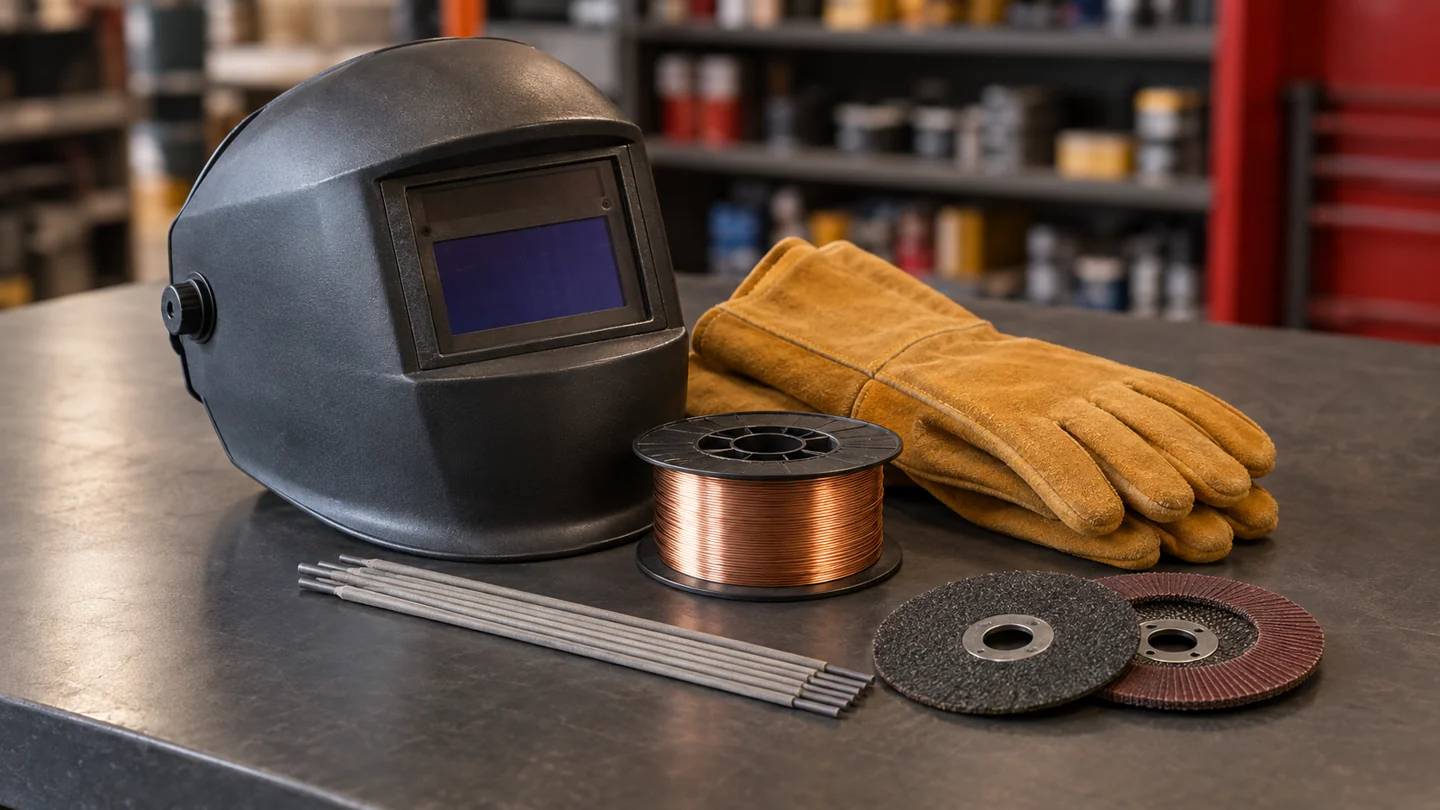
Buying welding supplies for a Wise County farm or fabrication shop starts with the job requirements, not a familiar package on the shelf. Electrode classification, wire type, machine compatibility, abrasive ratings, and protective equipment all need to fit the work. A product that performs well on one project may be inappropriate for another, even when both involve steel.
Holmes Auto Supply in Decatur supplies welding consumables, protective equipment, and shop tools. This guide helps you prepare a useful purchasing list and understand which questions need an experienced welder or a written procedure. It is not a welding lesson or approval to repair a trailer frame, hitch, lifting component, or other safety-critical assembly. Before an October restocking trip, identify the equipment, materials, and products your qualified operator actually needs, then call to check stock.
Planning Welding Supplies for a Wise County Shop
Start with the material, its thickness, and the intended use of the finished assembly. Identify whether the work involves clean known steel, coated material requiring a hazard assessment, thin sheet, or a component subject to structural loads. Appearance alone does not establish a metal's grade or weldability.
For load-bearing repairs, the first question is whether repair is permitted and how it must be performed. Trailer tongues, hitches, loader components, lifting points, and vehicle frames are not suitable for choosing a rod by a general blog recommendation. Consult the equipment manufacturer and an appropriately qualified welding professional.
Next, identify the machine and its capabilities. Bring the make and model, available output, gun or torch information, and the consumable specification from the procedure or operator's instructions. A process name by itself does not tell the counter which wire spool, contact tip, or electrode is compatible.
Our welding supplies and shop tools page lists the product categories Holmes carries. Stock varies by item and size, so use that list to organize questions rather than assuming every possible variation is available. Holmes supplies products; we do not perform welding or certify repairs.
Understanding 6011, 6013, and 7018 Electrodes
Electrode classifications describe important performance characteristics, but they are not complete instructions for selecting or using a product. Diameter, polarity, usable current range, welding position, base metal, and the approved procedure still matter. Check the exact manufacturer's data rather than relying on the first four digits alone.
E6011 is commonly associated with a forceful arc and deeper penetration than some general-purpose alternatives. That does not make it permission to weld through paint, oil, unknown coatings, or contamination. Surface preparation and hazard controls remain necessary, and unsuitable material may require a different approach entirely.
E6013 is commonly considered for suitable light fabrication and general-purpose applications. It is not a universal choice for thin material, nor does an easier arc compensate for inadequate training, poor fit-up, or a mismatched current setting. Buy the product specified for the planned work.
E7018 is a low-hydrogen classification used in applications that require appropriate control of materials and procedure. Calling it a “strength rod” oversimplifies the decision. Selecting E7018 does not by itself make a cracked frame, hitch, or loader component safe to return to service.
Polarity and power-source compatibility must be checked on the actual package and data sheet. Do not assume every product in a classification behaves identically on every AC or DC machine. The diameter also needs to fit the work and the machine's operating range, not merely the sizes a shop normally buys.
The counter conversation is more useful when the list names the complete product, classification, diameter, and quantity. If the operator has not yet selected a procedure or approved consumable, resolve that question before purchasing a substitute. A visually similar rod is not automatically an acceptable alternative.
Low-Hydrogen Rod Storage Is Part of the Purchase
Storage is especially important for low-hydrogen electrodes. Lincoln Electric distinguishes unopened hermetically sealed packaging from opened electrodes and specifies controlled storage and handling after opening. Simply putting exposed E7018 into an ordinary resealable container may not meet the required conditions (Lincoln electrode-storage guidance).
Use the instructions for the exact electrode and applicable welding procedure. Moisture-resistant designations, exposure limits, holding conditions, and permitted reconditioning can differ. Do not borrow a temperature or storage rule from another product, and do not use household cooking equipment to improvise a drying process.
Choose package sizes that fit the shop's actual consumption and storage capability. Keep identification with the electrodes so partially used stock does not become an unmarked mixture. Damaged packaging or uncertain exposure history should be raised with the welding supervisor before the material is used.
A restocking list should include storage needs as well as rod quantity. The purchase is incomplete if the operator cannot maintain the required condition after opening the package. Ask about the product documentation before assuming that “keep dry” covers every low-hydrogen application.
Solid Wire and the Two Types of Flux-Cored Wire
Solid wire used for gas metal arc welding requires the correct shielding gas and operating setup. Wire classification, diameter, spool dimensions, drive system, liner, contact tip, polarity, and gas requirements all need to match the machine and procedure. Indoor work still requires proper ventilation and hazard controls.
Flux-cored wire is not one interchangeable category. Self-shielded flux-cored wire is designed to operate without an external shielding-gas supply, while gas-shielded flux-cored wire requires the specified gas. Buying the wrong type because both packages say “flux-core” can leave a shop with an unsuitable setup.
Do not assume every self-shielded product uses the same polarity or that any flux-cored wire is appropriate for unrestricted outdoor use. Read the product data and machine instructions, including environmental limits. Wind, moisture, access, and fire conditions can make a location unsuitable even when the process is commonly used outside.
| Consumable type | Shielding arrangement | Details to confirm before buying |
|---|---|---|
| Solid wire for gas metal arc welding | Specified external shielding gas | Classification, diameter, gas, polarity, and machine compatibility |
| Self-shielded flux-cored wire | No external shielding-gas supply for its intended process | Exact product instructions, polarity, position, and operating limits |
| Gas-shielded flux-cored wire | Specified external shielding gas | Gas requirement, product classification, machine capability, and procedure |
The table compares buying requirements, not recommended settings. Follow the manufacturer's documentation and the applicable procedure for actual operation. There is no single spool size or wire diameter that covers every small shop machine and every job.
Contact Tips, Nozzles, Liners, and Gun Compatibility
Before buying gun consumables, identify the gun model rather than only the welder cabinet. A gun may have been replaced, and different consumable systems can look similar. Bring the old item or its exact part number along with the gun information.
Contact tips should match the manufacturer's recommended wire size and consumable system. Nozzles, diffusers, liners, and retaining parts also need the correct fit. An item that threads into place is not automatically approved for the gun or intended operating range.
Erratic feeding or repeated burnback can have several causes. Worn consumables, drive components, setup, or other equipment faults may need evaluation. Do not buy a liner solely because a general article labels it the usual cause of a symptom.
Keep a small, clearly labeled supply of the consumables the operator actually uses. Store them away from grinding dust and separate similar-looking sizes. Disconnect and secure equipment as its manual requires before inspection or replacement; leave electrical repairs and unfamiliar service work to a qualified person.
Abrasives: Match the Wheel to the Tool and Task
Abrasives must match the tool, guard, mounting arrangement, material, and intended operation. Confirm wheel diameter, arbor or attachment type, and the wheel's maximum operating speed against the tool's requirements. Never remove a guard to fit an oversized wheel or improvise an incompatible mounting arrangement.
Cutting wheels and grinding wheels are not automatically interchangeable. A wheel intended only for cutting must not be side-loaded for grinding. Inspect each product before use and follow its handling instructions; damage, incorrect mounting, or misuse can cause serious injury.
Flap discs combine coated abrasive segments for appropriate grinding and blending applications. Choose the backing style, material suitability, and grit for the job rather than assuming one disc can safely perform every task. Do not grind away a structural weld merely to make the surface appear smoother.
Coarser and finer grits serve different preparation and finishing needs, but the exact selection depends on the material and required result. Ask the operator for the specification rather than automatically replacing every empty position with the same grit. A cosmetic finish is not evidence of weld integrity.
Wire brushes also need the correct speed rating, attachment, and material compatibility. They can shed wires, and they do not replace required preparation or inspection. Include appropriate eye and face protection, hearing protection, and other task-specific equipment in the purchasing plan.
Store wheels and discs as directed and protect them from moisture, impacts, and crushing. Do not put questionable or unmarked abrasives back into the working supply. A readable label is necessary for checking the product's limits before use.
Helmet Shades and Eye Protection
Helmet shade selection depends on the process and operating conditions, including current and, where applicable, material thickness. OSHA provides process-specific minimum protective shades; it does not establish a universal “shade 5 for torches, shade 10 for every arc” rule (OSHA eye-protection requirements).
Use the applicable safety guidance, helmet instructions, and workplace assessment to select protection. Do not choose a lighter setting simply because the weld is difficult to see, and never go below the required minimum. Eye discomfort after welding is not a safe method of selecting a shade.
An auto-darkening helmet must be suitable for the process and current range, including low-current applications where relevant. Check its supported shade range, operating modes, sensor requirements, condition, and manufacturer-specified checks. Stop using a helmet that is damaged or does not operate correctly.
Grind mode is not welding protection. Confirm the correct mode before striking an arc and use the required safety glasses beneath appropriate face protection. Replacement cover lenses must fit the helmet and should be handled according to its instructions rather than substituted with an unknown material.
Remember nearby workers and bystanders. Screens and other controls may be needed to protect people who are not wearing welding helmets. Buying protection for the operator alone does not address every exposure around an active shop.
Clothing, Fumes, Fire, and Work That Needs a Specialist
Gloves need to suit heat exposure, dexterity, and the process, while protective clothing must be appropriate for sparks and radiant heat. Ordinary cotton clothing is not automatically adequate welding protection. Select suitable flame-resistant equipment and replace items that are damaged or contaminated.
Coated, painted, galvanized, or unidentified metal needs a proper hazard assessment before welding or cutting. An open door or working outdoors does not automatically control hazardous fumes. The work may require specific ventilation and respiratory protection determined by a qualified person, not a generic mask recommendation.
Keep chlorinated-cleaner vapors away from welding operations, and follow the safety data sheets for all cleaning and welding products. OSHA addresses cleaning compounds, hazardous coatings, ventilation, fire prevention, and work on containers in its welding requirements (OSHA welding and cutting guidance).
Do not weld or cut a tank, drum, sealed vessel, or container that may hold flammable residues based on a home cleaning method. Such work requires specialized evaluation and preparation. Confined-space work also requires specific controls and is outside the scope of this buying guide.
Remove or protect combustibles as required, assess where sparks can travel, and arrange suitable fire protection and any required fire watch. In farm settings, consider dry vegetation, bedding, feed, stored fuel, and concealed spaces. If the location cannot be made safe, the work should not proceed there.
Holmes also carries auto parts and shop supplies, but a cleaner or accessory being available does not establish that it is suitable for welding preparation. Check compatibility and safety documentation instead of combining products by habit.
Building a Restock List Across Wise County
Group the list by machine or work area: approved electrodes, wire, gun consumables, abrasives, protection, and layout tools. Record the full product identification and size for each item. That approach helps the counter check the exact requirement instead of guessing from a worn sample.
For customers planning trips from Chico or Alvord, checking stock first is more useful than assuming every size is available. Keep items that are essential to a planned job separate from general shelf replenishment so priorities are clear.
Call (940) 627-2350 with the item, product number when available, size, and quantity. If a particular product is unavailable, ask about sourcing and current expected timing. Have any proposed substitute approved for the application before treating it as interchangeable.
For a shared shop, identify who authorizes substitutions and who checks the final list. Keep unopened replacement consumables separate from used or uncertain stock. A clearly labeled shelf prevents a correct purchase from becoming a mistaken selection during the next job.
Visiting Holmes Auto Supply in Decatur
Holmes Auto Supply is at 803 W Main St, Decatur, TX 76234. Hours are Monday through Friday, 8:00 AM to 5:30 PM, and Saturday, 8:00 AM to 1:00 PM. We are closed Sunday, so plan around the Saturday early close.
Bring readable package information or the old consumable when it is safe to transport. For equipment-dependent parts, include the machine, gun, or helmet model rather than relying only on appearance. The counter can help identify products without making claims about the quality or safety of a completed weld.
Read our customer reviews for other customers' experiences and our store FAQ for purchasing information. Keep the distinction clear: Holmes sells welding supplies and tools, while qualified welders and the applicable procedures determine how those products are used.
Frequently Asked Questions About Wise County Welding Supplies
Which welding rod should a Wise County farm shop keep?
Stock the classifications and diameters required by the work your qualified operator performs, not a universal three-rod assortment. The machine, material, procedure, and storage conditions all matter. Safety-critical repairs need professional evaluation, and choosing E7018 alone does not establish that a frame, hitch, or lifting component is suitable for welding.
Do all flux-cored wires work without shielding gas?
No. Self-shielded and gas-shielded flux-cored wires have different requirements. Gas-shielded products need the specified external gas, while self-shielded products are designed for their stated process without that supply. Confirm the complete product identification, polarity, machine compatibility, and procedure before buying or switching wire, even when the spool looks similar.
What helmet shade do I need for stick or MIG welding?
Use the process-specific protective-shade guidance and helmet manufacturer's instructions for the actual operating conditions. There is no single setting for every stick or MIG application. Confirm the helmet supports the process and current range, use the correct operating mode, and never rely on eye discomfort afterward to judge whether protection was sufficient.
Can I keep opened 7018 in an ordinary sealed container?
An ordinary container may not meet the storage requirements for opened low-hydrogen electrodes. Follow the exact manufacturer's instructions and applicable welding procedure for exposure, holding, and permitted reconditioning. Keep product identification and exposure history with the stock, and do not assume closing a lid restores electrodes to their original packaged condition.
What should I do if a required consumable is unavailable?
Ask the counter about sourcing and current expected timing, then check any proposed alternative against the equipment instructions and welding procedure. Similar diameter or appearance does not make products interchangeable. The qualified person responsible for the work should approve substitutions where performance, safety, or procedure requirements are involved.
When can I visit the counter for welding supplies?
Visit Monday through Friday from 8:00 AM to 5:30 PM or Saturday from 8:00 AM to 1:00 PM. Holmes is closed Sunday. Call (940) 627-2350 to check stock before the trip, and bring the exact item identification, size, quantity, and relevant equipment details so the counter can check the match.