
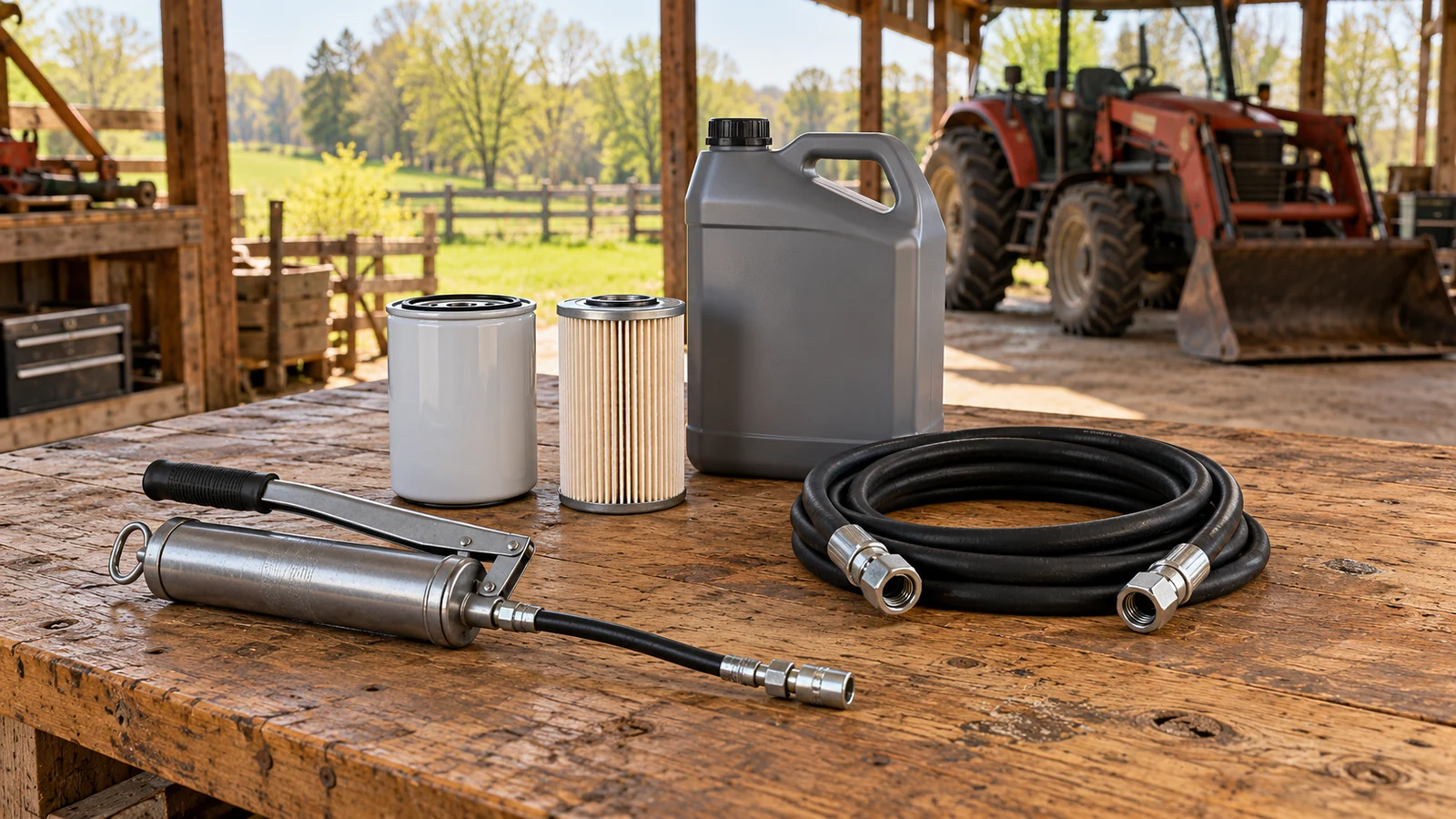
Every spring around Chico follows the same rhythm. The ground dries enough to work, the days get long enough to justify starting early, and everybody discovers at once that the tractor that ran fine in November has a flat tire, a weeping hydraulic line, and a fuel filter that nobody remembers changing. Chico is a small agricultural town in northern Wise County, and when planting season arrives here, it arrives for everyone at the same time. That is exactly why pre-season prep pays off: the week you actually need a part is the week everybody else needs it too. March is the month to walk every machine, write down what it needs, and get the consumables in one trip rather than making three separate runs during the only dry stretch of the month. This is a practical checklist for doing that.
Why a Pre-Season Walkaround Beats Chasing Breakdowns in Chico
There is a real difference between maintenance you schedule and maintenance that schedules you. A hydraulic hose that you replace in March because you noticed a chafed spot costs you twenty minutes in a shop with good light. The same hose failing in the middle of a field in April costs you the rest of the day, a mess to clean up, and possibly a load of contaminated fluid in a system you now have to flush.
The math gets worse the farther you are from parts. Chico is roughly 20 miles from our counter in Decatur, running TX-101 south and then US-380 east. That is a manageable trip, but it is forty miles round trip, and it is forty miles you do not want to make twice in one afternoon during planting. A written list turns three panicked trips into one planned one.
So start with a notebook, not a toolbox. Walk each tractor, each implement, and each trailer. Write down what you see, in the same order every time so you do not skip anything. Then consolidate the list before you pick up the phone.
Filters: The Best Insurance on a Tractor
Filtration is the single highest-leverage item on the list, because every filter you skip lets contamination into something expensive.
Engine oil filters
Change the oil filter every time you change the oil, not every other time. On equipment that sits for months between uses, calendar interval matters as much as hours — oil absorbs moisture and acids while sitting, and condensation in a crankcase does not care that the hour meter has not moved.
Fuel filters and water separators
This is the one that strands people. Diesel fuel in storage picks up water through condensation in the tank, and water in the injection system is genuinely destructive. Most tractors have a primary filter with a water separator bowl and a secondary finer filter downstream. Drain the separator bowl before the season, and keep draining it periodically once you are running. If you pull a filter and find rust-colored sludge or a milky layer, you have a fuel storage problem to solve as well as a filter to replace.
If your equipment has sat all winter with a partly empty tank, assume condensation. Full tanks over the off-season leave less air space for moisture, which is a habit worth building.
Air filters
Field work is dusty work, and around Chico it is often dusty caliche. Most tractors run a primary air filter with a safety element behind it. Inspect the primary, and if your machine has a restriction indicator, trust it over your eyes. Do not clean an element with a shop air hose blasting from the wrong direction, which drives dirt through the media and can tear pleats you cannot see. If the safety element is dirty, the primary already failed, and you should look at why.
Hydraulic and transmission filters
Many tractors share hydraulic and transmission fluid, and the filter that protects both is easy to forget because it does not have a convenient service light. Check the manual for the interval and inspect whatever screen or suction strainer the machine has. A clogged hydraulic filter can cause sluggish lift, noisy pumps, and heat, all of which get blamed on the pump long before anyone checks the filter.
Cabin filters
If your tractor has a cab, it has a cab air filter, and on a machine that works in dust it is usually far worse than the operator expects. Breathing matters.
Have your make, model, and engine information ready when you call about filters, because filter cross-references are one of the highest-variation categories in the store. Filters and related maintenance items live in our auto parts selection, and if something is not on the shelf, special orders most often arrive within one to two business days.
Hydraulic Fluid, Lines, and What to Look for Before the Season
Hydraulics do most of the real work on a modern farm, and almost every hydraulic failure sends a warning before it happens.
Fluid condition
Check the level cold and on level ground, the way the manual specifies. Then look at the fluid itself. Clear and bright is what you want. Milky or cloudy means water contamination. Dark and varnished means heat and age. A burnt smell means the system has been running hot, which usually points at a restriction, a low level, or a relief valve dumping continuously.
Match the specification exactly. Universal tractor transmission oils, hydraulic oils, and specialized wet-brake fluids are not interchangeable just because the color looks similar, and getting this wrong on a machine with wet brakes or a hydrostatic drive is an expensive mistake. Check the manual, and if you are unsure, bring the specification to the counter rather than guessing.
Inspecting hoses
Walk every hose on every implement with a flashlight and your eyes only. Look for:
- Abrasion, where a hose has been rubbing a frame member, a pin, or another hose — this is the most common failure cause in the field, and the fix is usually a clamp or a wrap, not just a new hose
- Weeping at the crimp, visible as a dirty, oily ring at the fitting collar, which means the crimp is failing
- Cover cracking or checking from ultraviolet exposure and age
- Blistering or ballooning, which means the inner tube has failed and pressure is getting into the reinforcement
- Kinks and tight bends, because a hose bent tighter than its minimum bend radius fails early and always at the same spot
- Corrosion or deformation at the fittings, and missing dust caps on quick couplers
- Hoses that are stretched taut through a full range of implement motion, which is a hose that will be pulled apart at some point
Rubber hose has a service life even when it looks fine. Age alone hardens the compound, and a machine that sat outdoors through several Texas summers has hoses that are older than their appearance suggests.
The one safety rule that matters most
Never use a hand to find a hydraulic leak. Escaping fluid can penetrate skin and cause a serious injection injury. Keep people clear, stop operation, and follow the machine's safe shutdown procedure without approaching a damaged line or raised load. Engine shutdown or cycling levers does not prove pressure is gone; accumulators and blocked circuits can retain energy. A qualified technician must follow the manufacturer's isolation and verified depressurization procedure before disconnecting a hose. Never loosen a fitting to release trapped pressure or use a rag as a shield. Seek immediate medical care for suspected injection and identify the fluid involved.
Replacing a hose
When a hose has to be replaced, bring us the old hose, a sample fitting, or accurate measurements. We cut and crimp custom hydraulic hoses on-site, most built the same day while you wait, matching inside diameter, pressure rating, fitting type, and thread across JIC, NPT, ORFS, and Metric. Measuring matters: overall length is measured from sealing surface to sealing surface, not including the hex, and the orientation of the two end fittings relative to each other matters on any hose that has to route around something. If the hose is in pieces, bring the pieces. You can read more about how that works on our hydraulic hoses page.
For equipment that runs hard all season, a spare hose for the assemblies you know are vulnerable is worth having in the shop before planting rather than after a failure.
Grease, Grease Guns, and Getting Lubrication Right
Greasing is the most basic maintenance there is, and it is still done badly more often than not.
Start with the gun. A pistol-grip gun is fine for a handful of fittings; a lever gun gives you more pressure for stubborn zerks. Cordless guns earn their keep on equipment with long fitting lists, like a baler or a heavy disc. Whatever you use, make sure the coupler actually seals — a worn coupler that blows off under pressure wastes more grease than it delivers to the bearing, and a locking coupler solves that problem on awkward fittings.
Use the lubricant specified for each component. A multipurpose lithium-complex grease may suit some applications, but moly content, thickener compatibility, and bearing suitability are equipment-specific. Do not assume a high-load pin grease is suitable for every rotating bearing or U-joint. Follow the maker's changeover procedure instead of mixing products or indiscriminately purging sealed components.
Practical points that make a difference:
- Wipe the fitting before you attach the coupler, because grease pushes whatever is on the zerk straight into the bearing
- Apply the specified quantity and method; not every bearing should be greased until grease exits a seal, and excess pressure can damage seals
- Replace broken or plugged zerks rather than working around them, and keep an assortment of straight, 45-degree, and 90-degree fittings on hand along with a zerk cleaner tool
- Service driveline slip joints and U-joints only with equipment isolated and stopped; never reach past an operating PTO shield
- Run a can of penetrating oil over pins and linkages that have not moved since fall, before you need them to move
Penetrants, aerosol lubricants, threadlockers, gasket makers, and cleaners are everyday counter stock, and the lines we carry include WD-40, CRC, and Permatex. You can see the full list on our brands page.
Chain, Hardware, Wire, and Fencing Tools for Chico Places
Spring on a Chico-area place is rarely just about the tractor. It is also everything that broke over the winter and nobody fixed.
Chain and hardware
Roller chain on augers, elevators, and balers stretches and wears. Check for stiff links, worn sprocket teeth that have gone hooked or pointed, and misalignment. Replacing a chain over worn sprockets just wears out the new chain faster.
For hauling and recovery, log chain, grab hooks, clevises, and D-ring shackles all have working load limits, and load-rated hardware is not the same thing as hardware-store hardware that looks similar. Do not mix them. Inspect for stretched links, gouges, and any link that has been heated or welded, and retire damaged chain rather than keeping it in the truck.
Then there is the bolt bin. Grade 5 and Grade 8 bolts, nylock nuts, flat and lock washers, clevis and cotter pins, hitch pins, shear bolts for implements that use them, and U-bolts. Every one of these is the item that stops a job cold on a Saturday afternoon. Keeping a stocked assortment saves more time than the drive costs you.
Wire and fencing
Fence work fills the spring calendar for farmers and ranchers around Chico. Barbed wire and net wire, staples and clips, stretchers and come-alongs, fence pliers, post drivers, insulators and grounding rods for electric fence, and a proper pair of wire cutters. Check your stretcher and come-along for cracked castings and frayed cable before you load them, because both fail under load and both fail badly.
Welding and fabrication
Most repairs on a working place end at a welder. Stick rod in the sizes and types you actually use, flux-core or solid MIG wire with the right contact tips and nozzles, grinding discs and cut-off wheels and flap discs, an auto-darkening helmet that still works, gloves, clamps, magnets, and squares. Consumables are exactly the kind of thing you discover you are out of at the worst moment. Our welding supplies and tools category covers the consumables and hand tools side of this, and it is worth restocking in March rather than in the middle of a repair.
One Trip Instead of Three
Here is the part that actually saves the most time. Consolidate.
Walk everything first and write the whole list before you call. Filters by machine. Fluids by specification. Grease, zerks, and a coupler. Hose measurements or the old hoses themselves. Chain, hooks, and shackles. A bolt assortment. Fencing hardware. Welding consumables.
Then call (940) 627-2350 and go through it. Give us year or model and engine information for filters, the fluid specification out of the manual, and part names or numbers where you have them, and tell us whether you need something the same day. We will check what is on the shelf while you are still in the shop. Anything that has to be ordered most often arrives within one to two business days, which is a very different situation in March than it is in the middle of planting.
We are at 803 W Main St in Decatur, on West Business 380 at the west end of town, about 20 miles from Chico by way of TX-101 south to US-380 east. Our hours are Monday through Friday from 8:00 AM to 5:30 PM and Saturday from 8:00 AM to 1:00 PM, and we are closed Sunday. There is no after-hours line, so if you are planning a Saturday of shop work, get your list confirmed before that 1:00 PM Saturday close. We have been locally owned and operated since 1985 and we have served Wise County farmers, ranchers, and rural drivers for nearly 40 years. Local details for your area are on our Chico, TX page.
Safety reference: Parker hydraulic safety guide. Use the instructions for your exact vehicle, machine, and product.
Frequently Asked Questions About Spring Equipment Prep Near Chico
What should I check first on a tractor that sat all winter?
Start with fluids and filtration: engine oil and filter, fuel filter and water separator bowl, air filter, and hydraulic fluid condition. Then batteries and cables, tires, and a flashlight inspection of every hydraulic hose for abrasion and weeping. Finally, grease every fitting and work penetrant into pins and linkages that have not moved since fall.
Can you build a replacement hydraulic hose for my implement?
Yes. We cut and crimp custom hydraulic hoses on-site, and most are built the same day while you wait. Bring the old hose, a sample fitting, or accurate measurements, and we will match inside diameter, pressure rating, fitting type, and thread across JIC, NPT, ORFS, and Metric. Measure sealing surface to sealing surface and note fitting orientation.
How far is the drive from Chico to your counter?
Roughly 20 miles, running TX-101 south and then US-380 east into Decatur. We are at the west end of town on West Business 380. Because it is a real drive, call (940) 627-2350 with your list so we can confirm availability before you load up and make the trip during a working week.
Do you carry farm and ranch supplies as well as auto parts?
Yes. Along with auto parts, we carry heavy-duty truck parts, welding supplies and tools, oilfield supplies, and farm and ranch supplies, plus custom hydraulic hoses built on-site. If you are not sure whether we stock a specific item, a phone call is the fastest way to find out before you drive in.
Should I keep spare hoses and filters on hand during planting?
For the assemblies you know are vulnerable, it is a reasonable habit. Equipment failures cluster during the busiest weeks, which is also when a round trip for parts hurts most. Stock the consumables you know you will use and the one or two hoses that have failed before, and get the rest on a list.
What information do you need when I call about filters?
Make, model, and engine details for the machine, plus the filter type you need and any part number printed on the old filter. Bringing the old filter to the counter is even better. More about how our counter and special orders work is on our FAQ page.