
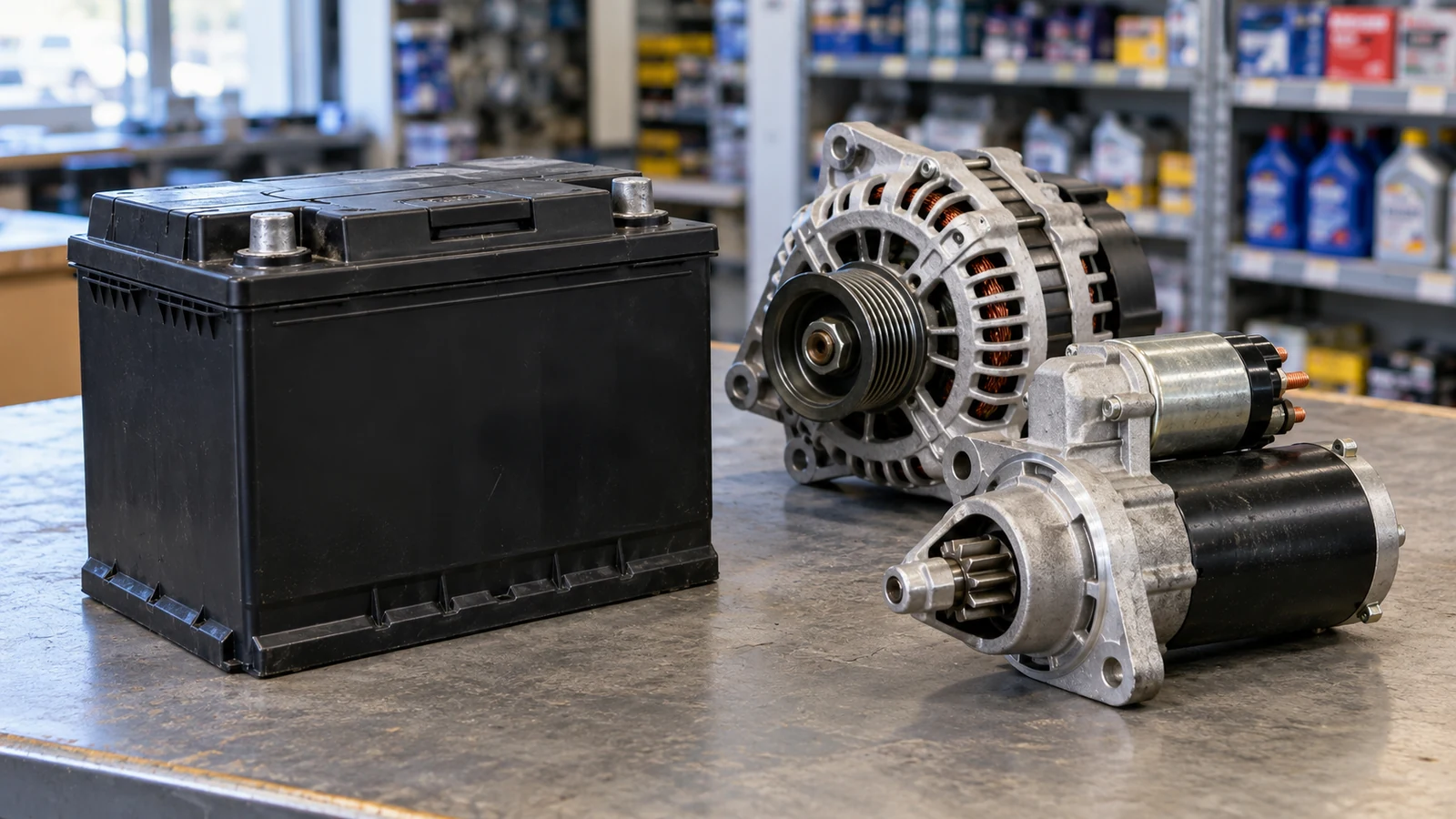
The first genuinely cold morning in Decatur does the same thing every January: it finds every marginal battery in Wise County and finishes it off. You turn the key, the dash lights dim, the starter groans once and then gives up, and suddenly you are standing in a driveway on West Main Street doing math about how late you are going to be. The frustrating part is that a no-start is not one problem. It is at least three different problems that all look identical from the driver's seat, and the difference between them is the difference between a part you need today and a part you did not need at all. This guide walks through how to separate a dead battery from a failing alternator from a bad starter using nothing more than your eyes, your ears, and a basic multimeter, so that when you come to the counter you already know what you are asking for.
Why Cold Mornings in Decatur Are So Hard on Batteries
A lead-acid battery is a chemical device, and chemistry slows down when it gets cold. At around 32 degrees Fahrenheit, a healthy battery can only produce roughly two-thirds of the cranking power it could on a mild day. Drop toward the teens, which Wise County does a handful of mornings most winters, and you are working with something closer to half. That is the first half of the problem.
The second half is that the engine is fighting back harder. Cold engine oil is thicker, so the starter has to spin a crankshaft swimming through something closer to syrup than oil. Cold fuel vaporizes less readily. So on the exact morning when your battery is weakest, the engine is demanding the most current it will demand all year. A battery that has been quietly losing capacity since August will pass every warm-weather test you throw at it and then fail on the first real cold snap.
This is why winter no-starts cluster: nothing changed overnight except the temperature, and the battery had been dying for months. If your vehicle has been cranking a little slower than it used to, if the headlights dim noticeably at idle, or if the battery is more than three or four years old, you are already on borrowed time. Those are the vehicles that strand people in January.
Decatur sits at the crossroads of US-380 and US-287, and that shapes how this plays out locally. A lot of people here are not driving across town, they are driving out of the county. A dead battery on a morning when you have a forty-minute run north on 287 or east on 380 is not a minor inconvenience. That crossroads position is also why our counter on West Business 380, at the west end of Decatur, sees so much of this traffic on the way in to work rather than after the fact. Stopping in on the way through is easier than arranging a tow later.
Dead Battery, Bad Alternator, or Bad Starter: Reading the Symptoms
Before you replace anything, spend five minutes listening. Each of these three failures has a signature.
The classic dead battery
Turn the key and you get slow, labored cranking that gets slower with each attempt, or a rapid clicking from under the hood, or nothing at all with dash lights that flicker and die. Headlights are dim or dead, the dome light barely glows, and the horn sounds weak or flat. Everything electrical is starved at once, because the one thing that feeds everything is empty.
A successful jump start points toward low available battery power, but it does not prove the battery is the failed part or that the starter and charging system are sound. Corroded connections, a parasitic drain, or a charging fault can produce the same result. Have the battery, cables, and charging system evaluated before buying a component.
A failing alternator
The alternator's job is to run the vehicle's electrical load once the engine is going and to put back the charge the starter just used. When it stops doing that, the vehicle runs off the battery until the battery is flat. This is why a bad alternator so often gets misdiagnosed as a bad battery — the battery really is dead, it is just dead because of something else.
Charging warning lights, changing headlight brightness, unusual accessory-drive noise, or a vehicle that stalls after a jump are reasons for a qualified charging-system diagnosis. None identifies the alternator conclusively: belt, wiring, battery, and control-module problems can overlap. Do not disconnect a vehicle battery while the engine runs to test an alternator; that can damage electronics.
A multimeter can provide a preliminary voltage observation, not a complete diagnosis. A rested, charged conventional 12-volt lead-acid battery often measures around 12.6 volts. Running voltage varies with temperature, battery condition, electrical load, and smart-charging strategy; many systems operate outside a simple 13.8-to-14.4-volt rule. Compare readings with the vehicle maker's procedure. Do not condemn an alternator from one idle reading, and keep probes, clothing, and hands clear of belts and fans.
A bad starter
A starter failure is the most specific-sounding of the three because the rest of the vehicle is unaffected. Headlights are bright, the radio works, and the dash is fully lit. You turn the key and get one solid, heavy click and then silence. Or you get nothing at all. Or you get a grinding noise, or a high-pitched whir with no engine rotation, which usually means the drive gear is not engaging the flywheel.
Do not strike a starter, bridge its terminals, or crawl beneath an unsupported vehicle to test it. A single click can come from a cable, ground, solenoid, control circuit, or mechanically locked engine. Let a qualified technician perform the prescribed voltage-drop and starting-circuit tests.
One caution before you condemn a starter: heavy voltage drop through corroded cables will produce exactly the same single click. Clean connections first, then test. It is the most common false positive we hear described at the counter.
Jump Starting a Car Safely, in the Right Order
Check the owner's manual before connecting anything. Use its designated 12-volt terminals, cable sequence, ground location, and donor-vehicle instructions. Some hybrid, electric, and stop-start vehicles have additional restrictions, and not every vehicle may serve as a donor. Never attempt to jump a high-voltage traction battery.
Inspect the battery from a safe distance first. Do not jump or charge a cracked, swollen, leaking, or suspected frozen battery. Keep sparks, cigarettes, and flames away, wear appropriate eye protection, and keep both vehicles secured with their parking brakes set. Do not let the vehicles touch.
For a conventional system whose manual permits jumper cables, connect positive to positive and use the disabled vehicle's specified remote ground for the final negative connection. Do not substitute a random painted bracket. Use adequately rated cables with insulated clamps, keep them clear of moving parts, and follow the manual for starting and disconnecting. If instructions or polarity are uncertain, stop and call roadside assistance.
A successful start is not proof that the battery is healthy or fully charged. A brief drive may not restore a deeply discharged battery; proper charging and a diagnostic check may be needed. Stop repeated cranking attempts if the engine does not start, and never run either engine inside a garage or another enclosed space.
Terminal Corrosion, Cables, and Grounds
A surprising share of winter no-starts are connection failures rather than component failures. The white, blue, or green crust on a battery terminal is not cosmetic; it is an insulator sitting in the highest-current path in the vehicle. The starter can pull several hundred amps, and a terminal with meaningful resistance will drop enough voltage across that crust to turn a healthy battery into a single sad click.
Battery cleaning also starts with the owner's manual: disconnection can require a memory-preservation or battery-management procedure. With the engine off, appropriate eye protection and acid-resistant gloves in place, follow the prescribed disconnection sequence, generally negative first. Keep tools from bridging terminals or contacting the body from a positive terminal. Use products intended for terminals, keep liquids out of battery vents, and reconnect and tighten to the specified procedure rather than guessing. Damaged cables or a leaking case need professional assessment.
While you are in there, follow both cables. The positive runs to the starter; the negative runs to the block and usually to the body. Corroded, stiff, or swollen cable ends and a loose engine-to-body ground strap cause the strangest electrical symptoms a vehicle can produce. Battery cables, terminal ends, cleaning brushes, protectant sprays, and dielectric grease are all ordinary counter items in our auto parts selection, and they are worth checking before you buy a starter you may not need.
Choosing a Replacement Battery in Decatur
When the battery really is the problem, three specifications matter more than anything else on the label.
Group size is the physical one: case dimensions, post locations, and hold-down pattern. Get it wrong and the battery either does not fit the tray or the cables do not reach the correct posts. Cold cranking amps, or CCA, is the current the battery can produce at zero degrees Fahrenheit while holding usable voltage — this is the number that matters in January, and meeting or exceeding the figure your vehicle was designed around is the sensible move, especially on a diesel. Reserve capacity tells you how long the battery can run the vehicle's electrical load on its own if charging fails, which is what buys you time to get somewhere useful.
Battery type matters too. Many newer vehicles with stop-start systems and heavy electronics loads require an AGM battery rather than a conventional flooded one, and substituting downward causes short service life. We stock the Continental Supreme and Continental Platinum battery lines, and you can see the rest of the lines we carry on our brands page.
Note honestly what we do and do not do here. We are a retail parts counter. We sell the battery, the terminals, the cables, and the tools; we do not test batteries or charging systems and we do not perform the replacement. What we can do is help you match the right group size and rating over the phone or at the counter so you make one trip instead of three.
Starters, Alternators, and What to Bring to the Counter
Starting and charging components are among the most variation-heavy parts on a vehicle. Two trucks that look identical in a parking lot can take different alternators depending on engine, output rating, accessory package, and build date. That is why "a starter for a half-ton pickup" is not enough information to pull a part.
Bring or be ready to state:
- Year, make, and model
- Engine size, and whether it is gas or diesel
- Drivetrain and trim where you know it, since these drive electrical options
- Amperage rating for an alternator, if it is stamped or on a tag
- The part number off the old unit, if it is legible
- The old part itself whenever practical
That last one matters most. Bringing the old starter or alternator to the counter lets us compare mounting ears, clocking, plug style, pulley type, and stud spacing directly, which eliminates the "it looked the same" failure mode. If a part is not on the shelf, special orders most often arrive within one to two business days.
If you want a sense of how that counter conversation usually goes before you make the drive, our reviews page collects what Wise County customers have said about it; you can read current customer feedback there.
Diesels and Work Trucks in a Wise County Winter
Diesel owners live this problem on a harder setting. A diesel has no spark plug to help it along. It starts on compression heat alone, so cold starting depends on glow plugs or an intake grid heater and on a starting system that can turn a high-compression engine fast enough to build that heat. Most diesel pickups run two batteries in parallel for that reason.
A few winter-specific points for the work-truck crowd around Decatur. Replace parallel batteries as a matched pair, because a weak battery drags its healthy partner down, and check the crossover cable, which is a common corrosion point. If the engine cranks strongly but takes several seconds to catch on a cold morning, look at the glow plug system or grid heater before blaming the starter. A block heater also reduces the load on the whole starting system. Batteries, cables, filtration, and related components for diesel pickups and larger trucks fall under heavy-duty truck parts, and the more detail you can give us on engine and application, the faster we can confirm what is in stock.
Ranchers, contractors, oilfield operators, and repair shops across the Decatur area all run into the same January pattern: equipment that sat through a cold week and will not turn over on Monday. The fix is usually preventable — clean connections, a battery of the correct rating, and a charging system that was verified rather than assumed.
Planning Your Trip Around Our Hours
We are at 803 W Main St in Decatur, on West Business 380 at the west end of town, and we have been locally owned and operated since 1985. Our hours are Monday through Friday from 8:00 AM to 5:30 PM and Saturday from 8:00 AM to 1:00 PM. We are closed Sunday, and there is no after-hours or emergency line.
That Saturday 1:00 PM close is worth planning around in winter. If you are diagnosing a no-start on a Saturday morning, do the voltage test early and call before noon. And if a cold snap is forecast for a Sunday, check your battery's age and terminal condition on Friday, not at 6:00 AM Monday.
Before you drive in from Alvord, Bridgeport, Chico, Paradise, Rhome, Boyd, or anywhere else in the county, call (940) 627-2350 with your year, make, model, and engine size and let us check availability first. One phone call is shorter than a wasted round trip, and it also lets us tell you whether something needs to come in on a special order. You can see the full list of communities we regularly serve on our Decatur, TX page.
Safety reference: Ford jump-start precautions. Use the instructions for your exact vehicle, machine, and product.
Frequently Asked Questions About Winter No-Starts in Decatur
How do I know if it is the battery or the alternator?
Starting behavior and warning lights are clues, not proof of a failed component. A jump can temporarily overcome several different faults. Have a qualified shop check battery condition, cable voltage drop, and charging operation using the vehicle-specific procedure. Never disconnect the battery while the engine runs as an alternator test.
Why did my battery die when it was fine yesterday?
Cold weather cuts available cranking power substantially while simultaneously making the engine harder to turn. A battery that was already down on capacity can pass every mild-weather test and then fail on the first freezing morning. Age matters too — once a battery is past three or four years, treat any slow crank as a warning rather than a quirk.
Do you test batteries or alternators at the store?
No, we are a retail parts counter in Decatur, not a service shop. We sell batteries, starters, alternators, cables, terminals, and the tools to work on them, and we can help you match the correct group size, cold cranking amps, and amperage rating. The testing and the work happen on your end or at a shop of your choosing.
What information should I have ready when I call?
Year, make, model, and engine size at minimum, plus whether the vehicle is gas or diesel, the part name or number if you have it, and whether you need it the same day. For alternators, the amperage rating helps. Call (940) 627-2350 and we will check what is on the shelf before you drive over.
Can I just clean the terminals instead of replacing anything?
Corrosion can restrict starting current, but cleaning is not a substitute for diagnosing a weak battery or damaged cable. Follow the owner's manual for safe disconnection, eye and hand protection, cleaning, and reconnection. Avoid shorting terminals with tools. If you are unsure about the procedure, ask a qualified shop to handle it.
How far in advance should I replace an aging battery?
If the battery is over three years old going into winter and the vehicle is cranking slower than it used to, replacing it before the first hard freeze is far less disruptive than replacing it in a parking lot. Our FAQ page covers more about how our counter and special orders work.