
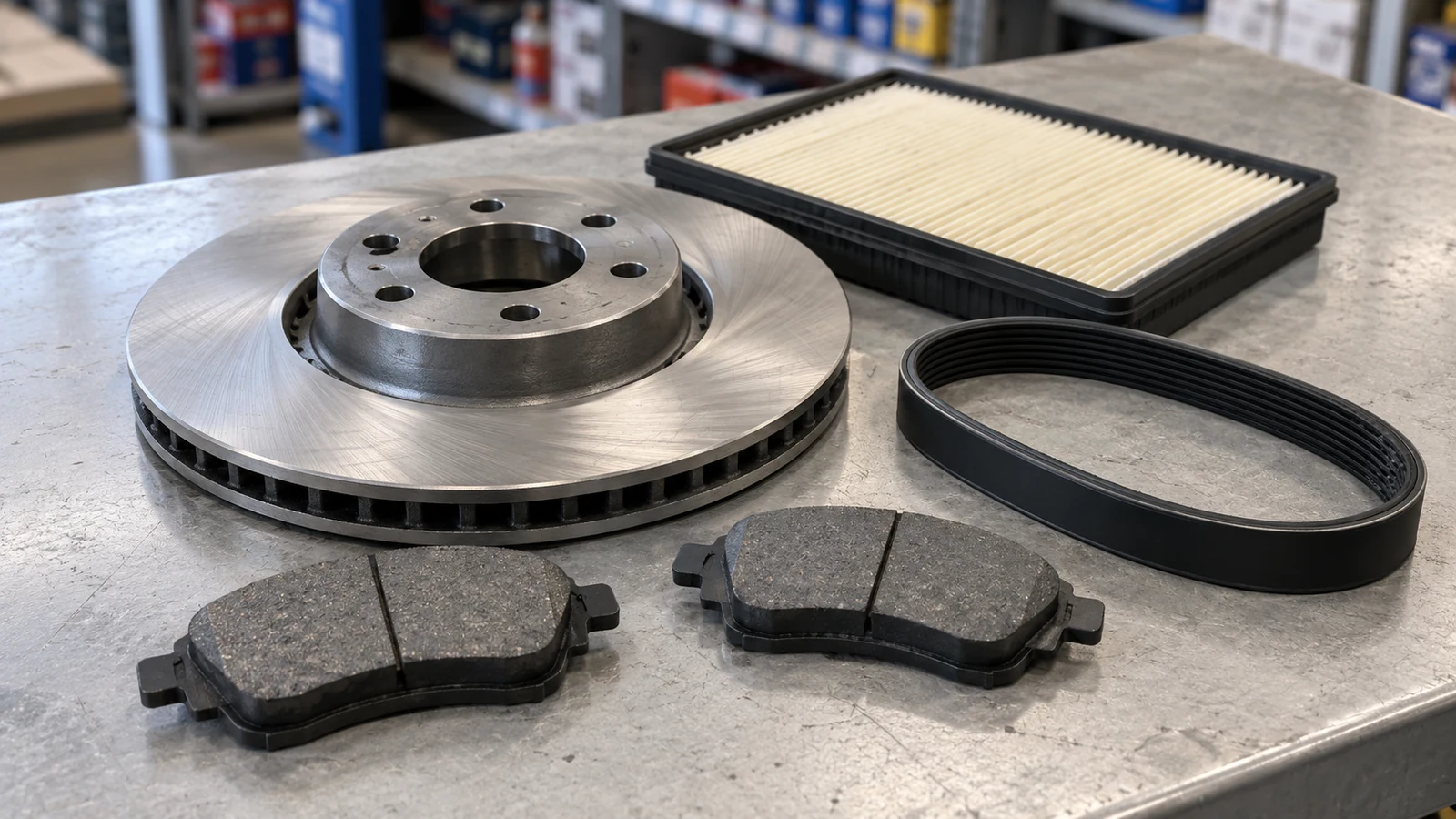
Rhome sits on the southern edge of Wise County right where suburban growth runs into working rural land, and that location does something specific to vehicles. If you commute down the I-35W corridor, you are not putting on gentle highway miles — you are putting on stop-and-go miles, and stop-and-go miles are the expensive kind. Brakes wear by heat cycles, not by distance. Belts age under load and under heat. Filters clog faster on a route that mixes construction dust, caliche, and slow traffic. February is a good month to get ahead of all three, because the weather is still cool enough to work in a driveway and you have not yet hit the spring stretch where everything seems to need attention at once. This guide covers how to read brake wear by sound and feel, how to diagnose a squealing belt properly, and how to build a mileage-based checklist you can actually keep.
What the I-35W Commute From Rhome Actually Does to a Vehicle
A vehicle's service life is driven less by odometer reading than by duty cycle. Two trucks with 90,000 miles can be in completely different condition depending on how those miles were accumulated. A truck that ran mostly open highway may be on its first set of brakes. A commuter that spends forty-five minutes a day braking, accelerating, and braking again in corridor traffic can be on its third.
Here is why. Every time you slow down, the brakes convert the vehicle's kinetic energy into heat. Friction material does not mind a single hard stop; what wears it out is the repetition of heat cycles, with the pad heating up, shedding material, cooling, and doing it again. Commuter traffic is nothing but heat cycles. Heavier vehicles make it worse because there is more mass to stop, and a lot of people in Rhome are commuting in full-size pickups that double as work trucks on the weekend.
The same duty cycle punishes the accessory drive. Idling in traffic means the engine spends long stretches at low rpm with the air conditioning compressor cycling and the alternator working to keep up with lights, blower, and electronics, all of it pulled through one serpentine belt. And it punishes filtration, because a slow-moving vehicle pulls in air that is full of whatever the vehicle in front of it just stirred up.
Rhome's mix matters here too. The town serves commuters, contractors, operators, tradespeople, farm and ranch owners, and repair shops, and a lot of vehicles do double duty — corridor commuting during the week and pasture roads or job sites on the weekend. That combination wears parts on two different schedules at the same time.
When to Replace Brake Pads: Reading Sound, Feel, and Thickness
Brake pads give plenty of warning before they become dangerous. The trick is knowing which warning is which.
The sounds
A high-pitched squeal that appears when you are moving and disappears the moment you press the pedal is usually the wear indicator. That little spring steel tab is designed to contact the rotor when friction material gets low, and it is doing exactly what it was built to do. This is your notice, not your deadline. Plan the job.
Grinding or grating felt through the pedal may mean severely worn friction material or another brake fault. Stop driving, park safely, and arrange professional inspection or towing rather than continuing a commute. A soft or sinking pedal, fluid leak, or sharply reduced braking also calls for immediate professional attention.
A brief noise after rain can come from surface rust, but do not dismiss recurring noise, pulling, or a changed pedal feel as normal. Describe when it happens to your mechanic.
Clunking on braking is usually hardware rather than friction material — worn slide pins, missing anti-rattle clips, or loose caliper mounting.
The feel
A pedal that pulsates, or a steering wheel that shimmies when you brake from highway speed, generally points to uneven rotor thickness or deposits of transferred friction material. A spongy pedal that travels farther than it used to points at hydraulics — air, moisture in the fluid, or a failing flexible hose. A pedal that slowly sinks under steady foot pressure at a light suggests a master cylinder that is bypassing internally. Pulling to one side under braking suggests a caliper that is sticking or a hose acting as a one-way valve.
The measurement
Sound and feel are indicators; thickness is the answer. New pads typically start somewhere around 10 to 12 millimeters of friction material. Most guidance treats roughly 3 millimeters as the point to plan the job and roughly 2 millimeters as the point to stop putting it off. You can often see the outer pad through the wheel spokes with a flashlight, though the inner pad frequently wears faster and requires pulling the wheel to inspect honestly. Check both.
Pads and Rotors: Why They Are Usually a Package Deal
The question we field most often at the counter is whether the rotors have to be replaced along with the pads. A few points to think through.
Rotors have a minimum thickness specification cast or stamped into the hub area, and once a rotor is at or below it, it has to be replaced. A thin rotor holds less heat, is more prone to warping, and has less margin for the next set of pads.
Modern rotors are also thinner from the factory than they were a generation ago, which leaves less material to work with over the vehicle's life. We should be clear here: we are a retail parts counter, and we do not have a machine shop and do not turn rotors. What we can do is help you compare the new rotor against the specification you measured.
Practically, new pads bedded against a scored, grooved, or heat-checked rotor surface will not seat evenly, which means reduced contact area, uneven wear, and often noise that no amount of shims will cure. If the rotor surface is not smooth and true, replacing both is the approach that actually works.
When you are selecting parts, decide honestly what the vehicle does. Ceramic pads are quiet, low-dust, and well suited to a commuter car. Semi-metallic pads handle heat and load better, which matters for a pickup that tows or hauls. Match the pad to the duty cycle, not to the sticker. Do not forget the hardware kit — new clips, shims, and slide pin lubricant prevent most comeback noise — and remember brake fluid is hygroscopic, meaning it absorbs moisture over time and lowers its boiling point.
Brake pads, rotors, hardware kits, calipers, hoses, and fluid are all standard counter items in our auto parts selection, and it helps enormously if you know your year, make, model, engine size, and whether the vehicle has rear discs or drums before you call.
Serpentine Belt Squealing: Diagnosing It Properly
A squealing belt is the most commonly misdiagnosed noise on a modern engine, because people hear squeal and immediately buy a belt when the belt is frequently innocent.
Start with when the noise happens, because timing narrows it fast. A squeal on cold start that fades after a minute or two often points to a glazed belt or a weak tensioner. A squeal that appears when you turn on the air conditioning or turn the steering wheel to the lock points to a load spike the drive cannot handle, which again is usually tension. A squeal that rises and falls with engine rpm and never goes away points to a pulley bearing — idler, tensioner, water pump, or an accessory. A chirp rather than a squeal, especially a rhythmic one, usually means pulley misalignment.
Now inspect. Shut the engine off and look at the belt with a flashlight. Old-style cracking across the ribs is one failure mode, but modern EPDM belts often do not crack visibly at all — they wear down in the rib profile, so the belt sits deeper in the pulley grooves and slips. A belt wear gauge, a small plastic tool that drops into the ribs, tells you far more than eyeballing does. Look also for glazing, which is a shiny, hardened surface, for missing chunks, and for fraying at the edges, which indicates misalignment.
Tensioner and pulley checks that require releasing spring tension or removing the belt belong to someone equipped to follow the service manual. Automatic tensioners can injure fingers or slip off a tool. Keep the engine off, key removed, and hands away from the belt path; some electric fans can start unexpectedly. A technician can check alignment, bearing condition, and tension without a running-engine hand test.
Have idler and accessory bearings checked under the specified shutdown and belt-removal procedure. Do not restart an engine with its belt removed as a noise test: cooling and other essential systems may be disabled.
Do not spray water, dressing, or other liquids onto a running belt. Avoid reaching into the drive while listening for a noise. Belt dressing does not correct worn ribs, poor tension, or misalignment. Gates belts and tensioners are among the lines listed on our brands page; call to confirm the exact application and current stock.
Losing a serpentine belt is not a minor breakdown. On most vehicles it drives the water pump and the alternator simultaneously, so a broken belt means you lose cooling and charging at the same time. On the I-35W corridor at rush hour, that is a bad place to discover it.
Cabin and Engine Air Filters: The Maintenance Nobody Does
Two filters get ignored more than any others, and both are usually accessible without tools or with hand tools only.
The engine air filter protects the intake from dust and debris. Follow the maker's service interval and inspection procedure, including any restriction indicator; holding a filter up to sunlight does not reliably establish its condition. Avoid compressed-air cleaning unless the manufacturer explicitly permits a defined method, and keep loose dirt out of the clean side while the housing is open.
The cabin air filter filters the air you breathe inside the vehicle, and on most vehicles it lives behind the glove box or under the cowl. A neglected cabin filter reduces airflow from the vents, makes the defroster sluggish on a cold Rhome morning, and can produce a musty smell. Rural driving loads these faster than the interval in the manual assumes, and if you spend time behind a tractor on a county road or on caliche, plan on checking it more often than the book says.
There are two others worth having on your radar. Oil filter changes happen with oil service, and the filter should be replaced every time rather than every other time. Fuel filters vary by vehicle — some are serviceable, some live inside the tank — and on a diesel this becomes one of the most important maintenance items you have.
Bring the old filter to the counter when you can, or have the year, make, model, and engine size ready. Filters are one of the highest-variation categories there is, and "it looks about the same size" is exactly how people end up making two trips from Rhome.
A Maintenance Checklist for Corridor Commuters
Use the maintenance schedule for your exact vehicle, including its severe-service criteria. Stop-and-go traffic, dust, towing, and short trips may qualify, but there is no single mileage table that fits every Rhome commuter.
- Before driving: look for leaks, damaged tires, warning lights, or a changed brake pedal. Measure cold tire pressure with a gauge against the door-label specification; appearance cannot establish safe inflation.
- At each scheduled oil service: use the specified oil and filter, and ask for brake, belt, hose, and fluid inspections.
- For air and cabin filters: follow the manual and inspect more often when its dusty-use instructions call for it.
- For belts, brake fluid, and coolant: use the prescribed interval and specification, not a universal replacement mileage.
- Before towing: verify tires, braking, lights, coupler, connector, safety chains, and the load against vehicle and trailer instructions.
Keep dates, mileage, and part numbers in a notebook or phone note. Shared vehicles benefit from one consistent log, so the next driver knows what was actually serviced.
For pickups doing double duty around Rhome, bed mats, tie-downs, toolboxes, mud flaps, and work lighting are in our truck accessories category. Check fitment and stock before planning the job.
Making One Trip Instead of Three
Rhome customers can reach Decatur using US-81/US-287 northbound; check a current route from your starting point before leaving. That is a perfectly reasonable drive once. It is a frustrating drive three times in one Saturday because the first pad set was for the wrong caliper and the second rotor was for the four-wheel-drive model.
So call first. Have your year, make, model, and engine size ready, plus the part name or number if you have it, whether you need it the same day, and any detail about trim or drivetrain. We can check what is on the shelf while you are still standing in your driveway. If something is not in stock, special orders most often arrive within one to two business days.
Our hours are Monday through Friday from 8:00 AM to 5:30 PM and Saturday from 8:00 AM to 1:00 PM, and we are closed Sunday. If you are planning a Saturday brake job, that 1:00 PM Saturday close is the single most important thing to plan around — get your parts confirmed and picked up early in the morning rather than discovering a missing hardware kit at noon. There is no after-hours or emergency line.
We have been locally owned and operated in Decatur since 1985, and we serve Rhome along with the rest of Wise County from 803 W Main St on West Business 380. You can see the surrounding communities we regularly help on our areas we serve overview, and the local detail for your town on the Rhome, TX page. To check stock before you head north, call (940) 627-2350.
Frequently Asked Questions About Commuter Maintenance in Rhome
How often should brake pads be replaced on a commuter driving from Rhome?
There is no fixed mileage, because wear depends on traffic, vehicle weight, and driving style. Stop-and-go corridor commuting wears pads considerably faster than steady highway driving. Inspect thickness at every tire rotation, plan the job around 3 millimeters of remaining friction material, and treat any grinding noise as immediate.
Do I have to replace rotors when I replace pads?
Not always, but frequently. If the rotor is at or below its minimum thickness specification, or if the surface is scored, grooved, or heat-checked, replace it. New pads will not seat properly against a damaged surface. We sell pads and rotors over the counter; we do not have a machine shop and do not resurface rotors.
My belt squeals only on cold mornings. Is the belt bad?
Maybe, but check the tensioner first. A cold-start squeal that fades is classically a glazed belt or a weak automatic tensioner. Inspect the belt ribs for wear, spin every idler pulley by hand feeling for roughness, and verify the tensioner arm moves smoothly and snaps back. Replacing a belt on a tired tensioner just produces another squeal.
How often should I change my cabin air filter?
More often than the manual suggests if you drive rural roads around Rhome. Dust from caliche, farm work, and construction loads a cabin filter quickly. Check it at least once a year, and replace it when airflow from the vents drops, the defroster gets sluggish, or the interior smells musty. It is one of the simplest jobs on the vehicle.
Can you tell me over the phone whether you have my parts?
Yes. Call (940) 627-2350 with your year, make, model, and engine size, plus the part name or number and whether you need it today. We will check availability before you make the drive from Rhome. Our FAQ page has more about how the counter and special orders work.