
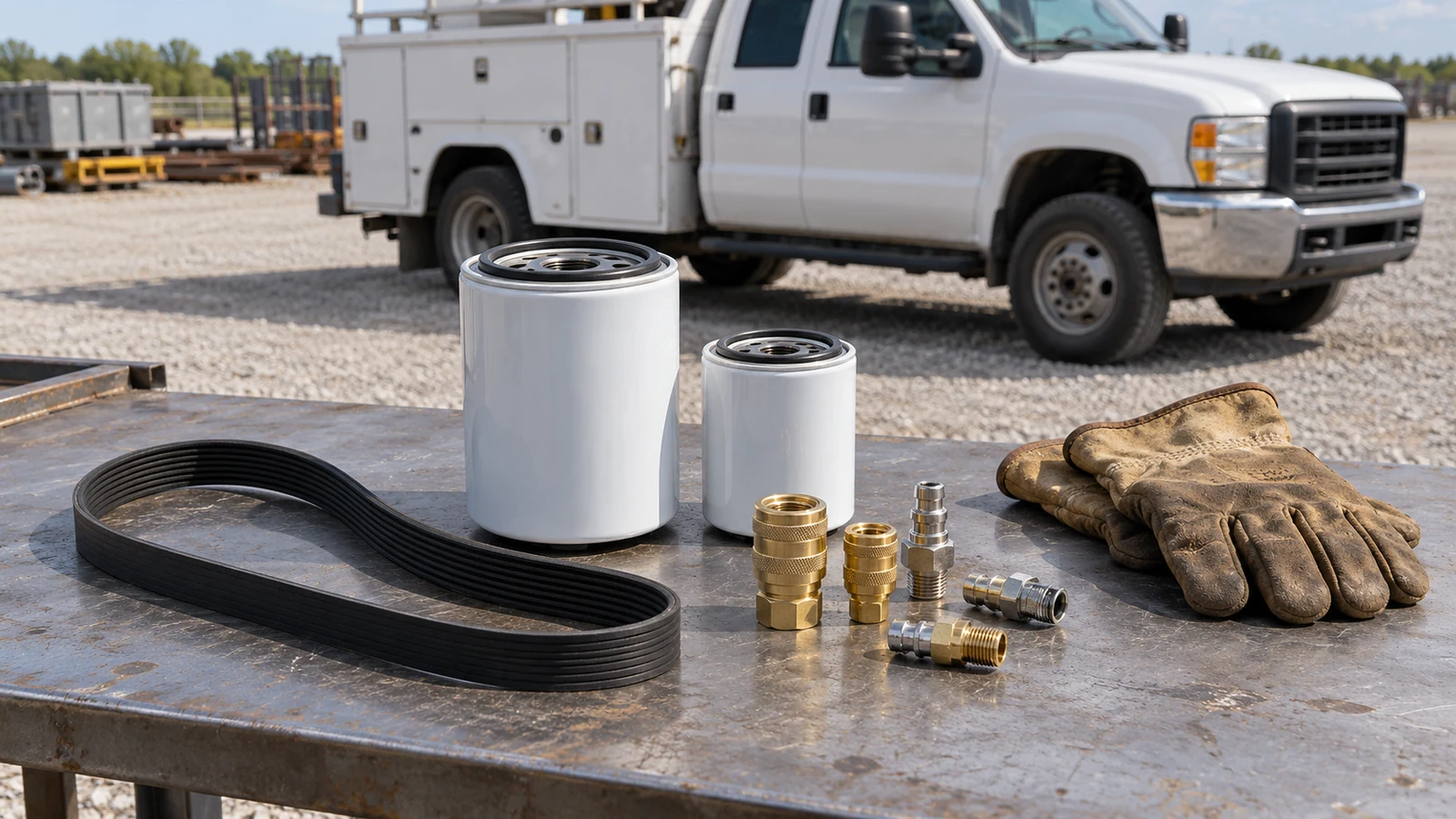
June is when work trucks around Bridgeport start telling on themselves. The dust is up, the heat is up, and a service rig or a one-ton flatbed that ran lease roads all spring has been shaking, heating, and breathing grit for months. Western Wise County keeps a lot of iron moving: oilfield crews, contractors, agricultural operators, shop owners, and tradespeople running trucks that have to start at daylight and stay out until the work is done. This is a look at what actually fails on those trucks under lease-road and summer-heat conditions, what to inspect before it puts a truck on the shoulder, and which parts are worth keeping either on the truck or on a shelf in the shop.
What Lease Roads Around Bridgeport Do to a Work Truck
Highway miles and lease-road miles are not the same miles. A truck running caliche and gravel every day lives with three things a commuter never sees.
Dust, constantly. Fine grit gets into air intake, cab filters, brake hardware, wheel bearings, u-joints, and every grease point. It makes an abrasive paste out of clean grease and it plugs filters far ahead of the mileage on the sticker.
Vibration and impact. Washboard surfaces and cattle guards work every bolted joint on the truck. That shows up as loose bed bolts, cracked exhaust hangers, broken shock mounts, split wire loom, chafed harnesses, leaking shock absorbers, and fasteners that walked out of brackets somewhere between the gate and the pad.
Heat with no airflow. Idling at a location in June with the air conditioning on and no road speed puts more thermal load on a cooling system than running down US-380. Add a dusty radiator core and a tired fan clutch and coolant temperature climbs fast.
The practical takeaway is that mileage-based service intervals are optimistic on a lease-road truck. Hour-based and condition-based inspection works better: look at filters, belts, hoses, and fasteners on a schedule you set by how dirty the truck gets, not by the odometer.
Air Brake Components and Slack Adjusters
On air-brake trucks, the brake system is the first thing a dusty, high-vibration environment attacks, and it is the system with the least room for a wait-and-see approach.
Slack adjusters convert air chamber pushrod travel into camshaft rotation. Excessive stroke needs brake-system diagnosis by a qualified air-brake technician. Do not repeatedly manually adjust an automatic slack adjuster to hide the symptom; the adjuster, installation, or foundation brake may be faulty. Stroke limits depend on chamber type and specifications, not one generic measurement.
Chambers and springs. Observe damage or air leaks from a safe position and refer them to a qualified air-brake technician. Spring-brake chambers store substantial mechanical energy. Never open a spring chamber or remove its retaining clamp; serious injury can result. Do not operate a truck with an unresolved braking fault.
Air lines, glad hands, and fittings. Rubber and nylon air lines chafe where they cross frame rails. Glad hand seals dry out, crack, and leak, and the rubber grommets are small enough to keep a few on hand. A leak you can hear is costing the compressor duty cycle all day.
Moisture and the air dryer. Air compressors make water, and water in an air system is the single most common cause of valve trouble. Drain the wet tank regularly, more often in humid weather, and replace the air dryer desiccant cartridge on schedule. Water that reaches a valve body eventually sticks it.
Drums, shoes, s-cams, bushings, and hardware. Heat-checked drums, cracked linings, dry s-cam bushings, and worn camshaft rollers all change how a brake performs. Grit accelerates every bit of it.
To be clear about roles: we sell these components over the counter, and the inspection and the work stay with your shop or your mechanic. Brake, chassis, and drivetrain components for medium and heavy trucks sit in our heavy-duty truck parts category, and it helps enormously to arrive with the year, make, model, engine, and axle information, plus the old part or its number when you have it.
Filtration Under a Dust Load
Every filter on a lease-road truck is working harder than the maintenance schedule assumes.
Engine air filtration is the one that quietly costs the most. A restricted air filter drives up fuel burn and exhaust temperature, and a filter that has been beaten on the tire to shake dust out has been damaged, not cleaned. Tapping a pleated element opens pinholes and lets grit straight into the intake, where it scores cylinder walls. Watch the restriction indicator if the truck has one, replace elements rather than clean them, and check the housing seal and the intake tube clamps every time the element comes out. A leak downstream of the filter defeats the filter completely.
Fuel filtration and the water separator. Diesel injection systems have tight clearances and no tolerance for water or abrasives. Drain the separator on a regular schedule and any time fuel comes from an unfamiliar source, since condensation in tanks is a constant in humid Texas summers. Change primary and secondary filters on schedule and prime the system properly after a change. When a truck starts hard, loses power under load, or hunts at idle, filtration and water are the first places to look.
Engine oil filtration. Under dust and idle-heavy duty cycles, oil picks up soot and grit faster. Follow the shorter end of the service interval for severe duty rather than the highway number, and use the filter specified for the engine rather than the closest lookalike on a shelf.
Hydraulic and transmission filtration. Service bodies, cranes, dump trailers, and PTO-driven equipment all have their own filters, and those are the ones most often forgotten. Contaminated hydraulic fluid destroys pumps and valves and then produces the pressure spikes that finish off hoses.
Filters, fluids, grease, funnels, drain pans, and shop consumables come off the same counter as the rest of our auto parts and supplies, which is worth remembering when you are stocking a shop shelf instead of fixing one truck.
Belts, Cooling, and Summer Heat
Cooling failures cluster in June, July, and August for obvious reasons, and on a truck that idles at a location they cluster harder.
- Serpentine belts. Modern EPDM belts do not crack the way old belts did; they wear thinner and lose rib depth, which shows up as slipping under load rather than squealing. Look for glazing on the rib faces, missing chunks at the rib edges, and pilling of rubber in the grooves. A belt gauge tells you more than your eyes.
- Tensioners and idlers. A tensioner is a spring and a bearing, and both wear. Spin the idlers by hand with the belt off and feel for roughness. A tensioner that cannot hold tension eats belts and water pumps.
- Radiator and heater hoses. Squeeze a cold upper hose. Mushy means the inner liner has degraded, hard and glassy means it is ready to split, and a hose that has swollen near a clamp is done. Replace clamps with hoses.
- Radiator and charge air cooler. Dust packs the core fins from the outside and turns a good radiator into a bad one. Clean the core carefully from the engine side outward with low pressure, not a pressure washer at close range that folds the fins.
- Fan clutch. A fan clutch that will not engage lets temperature climb only at idle and low speed, which is exactly the lease-road pattern. A clutch that never disengages roars and costs fuel.
- Coolant. Use the type the engine calls for and do not mix chemistries. Mixing coolant technologies can produce sludge and drop out the additives that protect liners and heat exchangers. Test condition rather than judging by color.
- Thermostat and water pump. A weeping pump seal or a thermostat that opens late shows up as temperature swings before it shows up as a breakdown.
Belts and hoses from the brands we stock, Gates among them, cover a wide range of truck applications. Bring the old belt or its part number, or the truck's year, make, model, and engine size, so the replacement matches.
Hydraulic Hoses on Service Rigs and Dump Trailers
This is the failure that most often stops a work day cold, and it is the one we can turn around fastest.
Hoses on service bodies, cranes, dump trailers, wreckers, and PTO-driven equipment fail from the same causes every time: abrasion where a hose rubs a frame member or another hose, cover degradation from heat and ultraviolet exposure, a bend tighter than the hose's minimum radius, twist or tension at installation, and pressure spikes that finish off a hose already weakened by the first four.
Never use a hand to find a hydraulic leak. Escaping fluid can penetrate skin and cause a serious injection injury. Keep people clear, stop operation, and follow the machine's safe shutdown procedure without approaching a damaged line or raised load. Engine shutdown or cycling levers does not prove pressure is gone; accumulators and blocked circuits can retain energy. A qualified technician must follow the manufacturer's isolation and verified depressurization procedure before disconnecting a hose. Never loosen a fitting to release trapped pressure or use a rag as a shield. Seek immediate medical care for suspected injection and identify the fluid involved.
Once the line is off, bring it to us. We build custom hydraulic hoses on-site, cut and crimped at the counter, with most built the same day and often while you wait. Bring the old hose, a sample fitting, or measurements, and we match inside diameter, pressure rating, fitting type, and thread across JIC, NPT, ORFS, and Metric ends. If you are calling first, the useful details are the ID, the end-to-end length, the fitting type and thread on each end, elbow angles, and the working pressure printed on the old cover.
For a fleet, a qualified maintenance team can identify hose assemblies worth keeping as spares and correct rubbing or routing problems. A spare does not make removal or installation safe without isolation and pressure verification. Plan the work around the equipment procedure rather than assuming a quick swap is routine.
Field Repair Supplies and Welding Consumables
Contractor and oilfield work generates the kind of damage that gets fixed on the spot: a cracked bracket, a broken gate hinge, a bent step, a mount that tore loose from vibration.
Keeping consumables stocked is what makes that possible. Stick rod in the sizes your shop actually runs, MIG wire whether solid or flux-core, contact tips, nozzles, grinding and cut-off wheels, flap discs, wire brushes, anti-spatter, soapstone, chipping hammers, clamps, magnets, squares, gloves, and lenses for auto-darkening helmets all live in our welding supplies and tools section along with oilfield and farm supplies.
The same goes for the small hardware that disappears fastest on a work truck: grade-rated bolts, nuts, washers, cotter pins, clevis pins, hose clamps, zip ties, loom, terminals, heat shrink, wire, fuses, relays, marker lights, thread locker, gasket maker, penetrating oil, and brake cleaner. None of it is glamorous and all of it is the difference between a field fix and a tow.
What to Keep on the Truck and on the Shelf
Shops and owner-operators around Bridgeport tend to settle on a similar list. A reasonable starting point:
On the truck: spare belt for the engine, an assortment of hose clamps, a gallon or two of the correct coolant, oil to top off, a spare fuel filter, glad hand seals and a spare air line, an assortment of fuses and bulbs, wire, terminals, electrical tape, zip ties, a basic hand tool set, a torque wrench, jumper cables, a work light, and gloves.
On the shop shelf: filters for every unit in the fleet, belts for the trucks that run hardest, common hydraulic fittings and adapters, spare hose assemblies for known trouble spots, brake hardware kits, grease, thread sealant, and enough welding consumables to get through a week without a trip.
The point of a shelf is not to hoard. It is to keep a truck out of a two-day wait for a small item nobody thought about. Most special orders arrive within one to two business days, which is fine for planned work and painful when a rig is down, so the items that stop work are the ones worth stocking.
Shop Accounts, Hours, and the Drive From Bridgeport
Bridgeport is the hub of western Wise County and its second-largest city, sitting near Lake Bridgeport about 18 miles west of us on US-380, roughly a 20 minute drive to our counter at 803 W Main St in Decatur. That corridor carries a lot of working iron in both directions, which is why so much of our day is spent with oilfield crews, contractors, shop owners, and work-truck operators rather than with passenger cars.
For shops and contractors who buy regularly, we handle shop accounts and contractor relationships, with the terms worked out by phone. If you run a crew and want the details of a shop account, that is a conversation to have with us directly at (940) 627-2350. We have been locally owned and operated since 1985 and welcome customers from throughout the county, and you can read what other customers say on our reviews page.
Plan around our hours, because work-truck problems rarely respect them. The counter is open Monday through Friday 8:00 AM to 5:30 PM and Saturday 8:00 AM to 1:00 PM, and we are closed Sunday. There is no after-hours or emergency line. A truck that goes down at 6:00 PM Friday is a Saturday-morning parts run at best, so the Friday afternoon call is worth making before a crew is scheduled for Monday.
Get More Out of the Phone Call
A good parts call takes two minutes and saves an hour. Have this ready before you dial:
- Year, make, and model of the truck, plus engine size. On diesels this matters more than anything else, since one model year can carry more than one engine.
- The VIN if it is handy, and the part number off the old part if there is one.
- Axle, transmission, or hydraulic system details for drivetrain and hydraulic items.
- Whether the truck is down now or the part is for planned service, because that changes what we look for.
- For hose work, the ID, length, fitting types, and pressure.
Then tell us plainly what the truck is doing. Symptoms narrow parts faster than guesses do.
Safety reference: NTSB automatic slack-adjuster safety recommendation. Use the instructions for your exact vehicle, machine, and product.
FAQ: Work Truck Parts Questions From Bridgeport Customers
Does the Decatur counter stock heavy-duty truck parts?
We stock heavy-duty and medium-duty truck parts along with auto parts, oilfield supplies, farm and ranch supplies, welding supplies, and truck accessories. Bring or call in the year, make, model, engine, and axle information, plus a part number if you have one. If an item is not on the shelf, most special orders arrive within one to two business days.
How fast can a hydraulic hose for a service rig be built?
We cut and crimp hoses on-site, and most are built the same day, frequently while you wait at the counter. Bring the old hose, a sample fitting, or the measurements, and we match inside diameter, pressure rating, fitting type, and thread across JIC, NPT, ORFS, and Metric. Calling ahead with the ID, length, and fitting types lets us confirm what is on hand before the 18-mile drive.
How often should filters be changed on a truck running lease roads?
Sooner than the highway interval. Dust loads air and hydraulic filters fast, and idle-heavy duty cycles push soot into engine oil. Use the severe-service side of the manufacturer's schedule, watch the air restriction indicator, drain the fuel-water separator regularly, and never clean a pleated air element by tapping it, which damages the media.
Can a shop set up an account for regular parts buying?
Yes. We work with shops, contractors, and fleets through shop accounts, and the terms are discussed by phone rather than online. Call (940) 627-2350 and tell us what kind of trucks and equipment you run so the conversation is useful from the start.
Does Holmes Auto Supply work on trucks?
No. We are a retail parts counter: we sell parts and supplies and we build hydraulic hoses on-site. We do not perform repairs and we do not come to your location or haul parts out to a job site. The fastest path is a phone call to confirm stock, then a trip to the counter with the old part or the measurements in hand.