
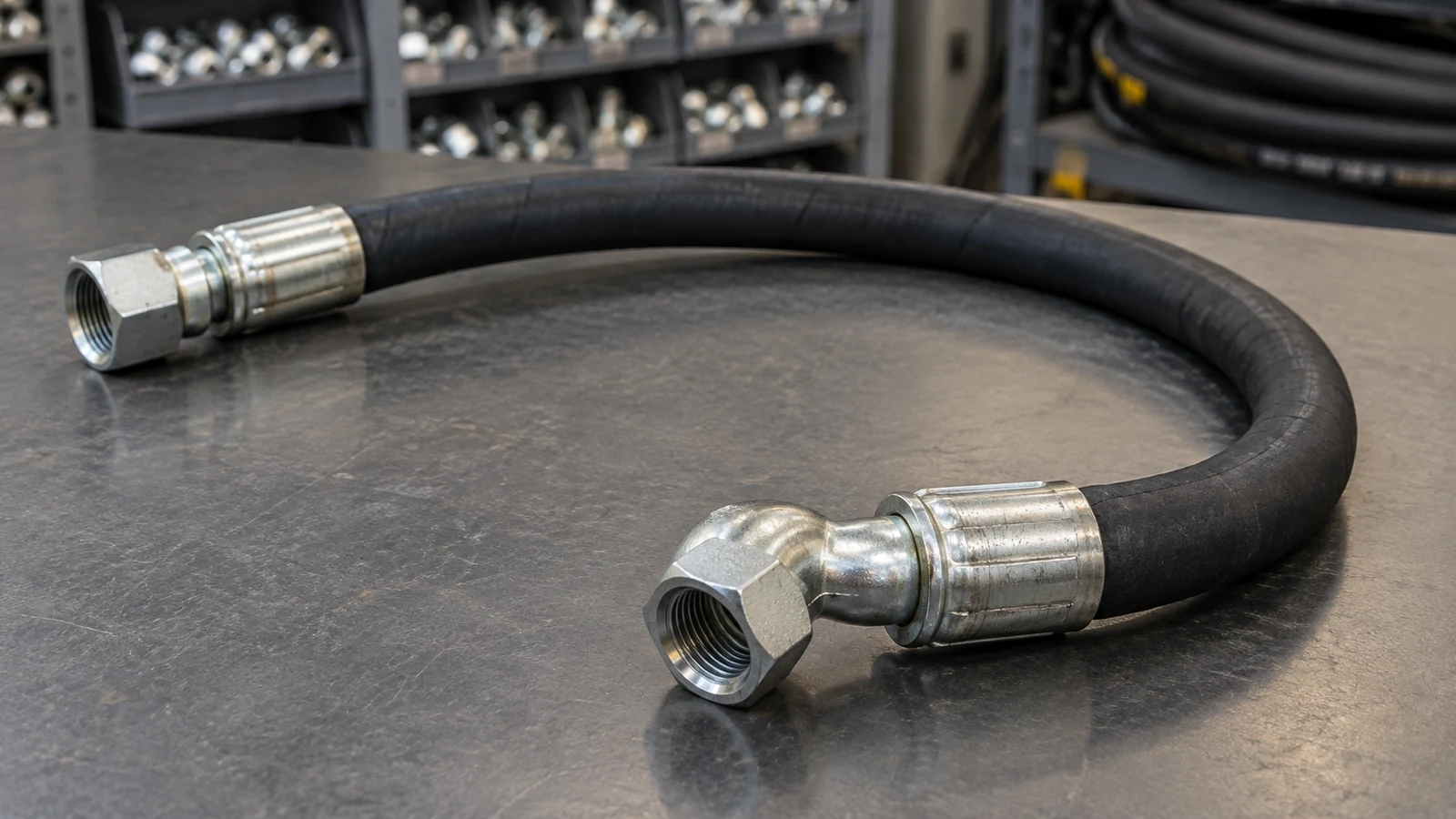
April is the month hydraulic hoses pick their moment. The loader has been working brush since February, the box blade is back on the three-point, and the disk is finally moving dirt again. Then a hose lets go mid-pass, a fine mist sprays across the boom, the bucket sags, and the day stops. If you farm or ranch around Paradise, you know the feeling: the machine is sitting in a field thirteen miles west of Decatur and the only real question is how fast a replacement hose can be in your hands. Here is why hoses fail, how to shut a machine down safely before going anywhere near the leak, and what to bring to our counter so a new hose can be built to match the one that blew.
Why Hydraulic Hoses Fail on Paradise Farm Equipment
A hydraulic hose almost never fails for one reason. It fails because two or three ordinary conditions stacked up over a few seasons and finally met a pressure spike.
Abrasion is the number one killer. Pull the failed hose and you will usually find a flat, shiny, worn patch on the cover, where it rubbed a frame rail, a cylinder barrel, or another hose every time the implement cycled. The cover protects the wire reinforcement underneath. Once it wears through, the braid holds moisture and dirt, rusts, loses tensile strength, and eventually cannot contain working pressure. On brush-country equipment the wear often comes from outside: mesquite, cedar stobs, and fence wire dragging along a loader arm.
Age and heat harden the rubber. Hose is a rubber product with a service life whether the machine works hard or sits. Oil temperature, Texas heat, and ultraviolet exposure drive out the plasticizers that keep the tube and cover flexible. Squeeze one: if it feels like conduit and the cover shows fine cracks when bent, it is living on borrowed time. Hoses on a machine parked under a tree for five years are often worse off than hoses that worked every week.
Wrong bend radius does slow, invisible damage. Every hose construction has a minimum bend radius. Bend tighter and you collapse the tube on the inside of the curve and stretch the reinforcement on the outside. You will not see the failure that day. You will see it two hundred hours later at the tightest part of the arc. The same applies right behind a fitting: the first inch or two behind a crimped end has to stay straight, because the hose cannot flex there at all.
Pressure spikes finish the job. Bottom a cylinder, catch a full bucket of wet clay, or slam a lever from one direction to the other and system pressure momentarily jumps well above the normal working number. A new hose shrugs that off. A hose with rusted braid and five years of heat cycles handles it until it does not.
Twist, tension, and bad routing. A hose should never be installed under tension or with a twist in it. Pressurized hose changes length slightly, so it needs slack. Twisted hose is worse: the braid layers fight each other and the hose fails at a fraction of its rated life. Dirty fluid adds to all of it, scouring the tube and hammering pump and valve components that then create harsher pressure pulses.
Around Paradise, most hoses brought to the counter come off loaders, box blades, hay equipment, grain augers, skid steers, dump trailers, and older tractors rebuilt and repurposed more than once. That last category matters: when an implement has been modified, the original hose lengths and routings are long gone, and a replacement has to match what is on the machine now.
The First Minute: Shutting the Machine Down Safely
When a hose bursts, the instinct is to jump off and look. Slow down. The sequence below takes under a minute and it is the difference between a parts errand and a trip to the hospital.
- Get the implement down and supported. Lower the loader, blade, or bucket to the ground before you shut anything off, if the machine still has the function to do it. A raised implement held up only by hydraulic pressure is a falling implement as soon as that pressure bleeds off through the break.
- Bring the engine to idle, then shut it off. Do not keep working to finish the row. Every second at pressure pumps more fluid out of the break, draws the reservoir toward the point where the pump sucks air, and sprays more oil on a hot manifold.
- Pull the key and set the park brake. On a tractor, drop the three-point and take it out of gear. On a skid steer, follow the machine's lockout procedure for the lift arms.
- Stay clear until the spray stops. A pinhole failure can keep a fine, nearly invisible stream going for several seconds after shutdown as pressure bleeds down.
- Let hot surfaces and hot oil cool. Hydraulic fluid coming off a working machine in April is hot enough to scald, and it is flammable when atomized. If any landed on an exhaust or turbo, keep an extinguisher within reach and stay with the machine a few minutes.
- Deal with the spill. A burst hose can dump gallons. Absorbent and dry sand keep it from becoming a longer problem, especially near a stock tank or creek crossing.
Never Hunt a Hydraulic Leak With Your Hand
This is the most important paragraph in this post. Do not run your hand, your finger, or any part of your body along a hydraulic line to find a leak. Farm equipment hydraulics run at pressures high enough that a pinhole leak produces a jet that penetrates skin without any obvious cut. That is a fluid injection injury and a surgical emergency. The entry wound can look like a splinter puncture and can be nearly painless for the first hour. Injected oil then spreads through the tissue and the tissue starts to die. Delayed treatment is how people lose fingers and hands.
A leaking hose is not a hands-on troubleshooting project. Keep away from the spray and damaged line, isolate the equipment under its manufacturer's procedure, and leave leak tracing to a trained person. Cardboard is not a reason to approach a pressurized leak yourself. Shutdown alone does not establish that trapped pressure has been relieved.
If anyone does take an injection injury, treat it as urgent no matter how small it looks. Get to an emergency room and say explicitly that it is a high-pressure hydraulic fluid injection injury, not a simple puncture, because the treatment path is different. That sentence saves hands.
Stored Hydraulic Pressure: Leave Disconnection to a Qualified Technician
Shutting the engine off does not empty a hydraulic system. Cylinders, load-holding valves, blocked circuits, and accumulators can retain dangerous energy after shutdown. Moving a control lever is not proof that every circuit is depressurized.
Keep people clear of raised or unsupported equipment. Follow the operator's safe shutdown procedure only if it can be done without approaching the damaged line; do not climb under a raised bed or implement to place a block. Have a qualified technician isolate the machine, safely support loads, and follow the manufacturer's circuit-specific pressure-release and verification procedure.
Never crack a fitting to bleed off pressure. A shop rag, gloves, or safety glasses cannot make that practice safe. Do not disconnect, tighten, or cap a line until the trained person has verified the relevant circuit is safe to work on.
After safe removal, protect the disconnected ports against contamination. Ask the technician to record the hose routing, overall dimensions, and fitting orientation, and photograph the markings from a safe position. Bring the removed assembly or that information to our counter. We build the replacement hose; we do not perform field removal, installation, or equipment repair.
What to Bring to the Counter in Decatur
Here is where a farm breakdown turns into a same-day fix. We build custom hydraulic hoses on-site at 803 W Main St in Decatur, cut and crimped to match what you bring us. There are three ways to give us what we need, best to workable.
Best: bring the old hose. The whole assembly, both fittings still attached, even if it is shredded in the middle. The old hose carries almost every answer: inside diameter, fitting types, thread sizes, elbow angles, overall length, and the layup printed on the cover.
Second best: bring a sample fitting. If the hose is unrecoverable but you have one of the ends, an identical hose off the other side of the machine, or the matching fitting off the port, bring that. Hardware in hand eliminates guesswork about thread type, which is where most mismatches happen.
Workable: bring accurate measurements. If the hose cannot come off, or the machine is down in a field and you are making one trip, write the following down:
- Hose inside diameter, not outside. The layline printed on the cover often states the size. A dash number such as -06 or -08 is the ID in sixteenths of an inch.
- Length, and how you measured it. For most assemblies the number that matters is end of fitting to end of fitting.
- Fitting type on each end, and whether it is male or female.
- Thread size across the flats, or a photo of each end next to a tape measure.
- Elbow angle and orientation. Straight, 45 degrees, or 90 degrees, and how the ends are rotated relative to each other.
- Working pressure printed on the old cover, plus what circuit it serves. A return line and a high-pressure loader line are not interchangeable.
- Machine details. Year, make, and model of the tractor, loader, or implement.
Photos of both fittings, the layline, and the routing let us talk through the assembly before you make the drive.
How the Counter Matches ID, Pressure Rating, Fitting Type and Thread
A hydraulic hose assembly is four decisions, and getting any one of them wrong means a hose that leaks, bursts, or simply will not thread on.
Inside diameter sets flow. Undersize the ID on a high-flow circuit and you create heat, pressure drop, and a sluggish implement. We match the ID of the hose you bring in.
Pressure rating has to meet or exceed what the circuit sees, with burst rating well above that. Single wire braid, double wire braid, and multi-spiral hose all carry different working pressures and different minimum bend radii at the same ID. A hose that fits the fittings but not the pressure fails again.
Fitting type is where most roadside guesses fall apart, because several styles look similar at arm's length. We work across the four common families:
- JIC, a 37-degree flare that seals metal to metal on the cone. Very common on agricultural equipment.
- NPT, a tapered pipe thread that seals on the threads themselves. The taper is visible looking down the thread.
- ORFS, o-ring face seal, sealing on a captured o-ring in the flat face rather than on threads or a cone. Common on newer equipment.
- Metric, found on imported tractors, compact equipment, and many attachments, and able to resemble an inch-standard fitting while being completely incompatible.
Thread size and gender finish the job. Two JIC ends can be the same style and still not mate, and a fitting that starts to thread and then binds is telling you something. Bringing hardware to the counter settles all of this in a minute instead of a second trip. If the assembly needs an adapter to reach a port thread, tell us what the port is.
Hoses Cut and Crimped On-Site, Most Built Same Day
Our hose work happens at the store. We cut hose to length and crimp the fittings on our own equipment, and most hoses are built the same day, often while you wait at the counter. That is the whole point for a Paradise farm: nobody is waiting on a distribution center while a loader sits mid-job.
A few things that make the visit go faster:
- Call ahead. A quick call to (940) 627-2350 with the ID, length, and fitting types lets us confirm what we have on hand before you drive in.
- Bring the old hose even if it looks destroyed. Shredded is fine. The fittings are the valuable part.
- Buy the second one. If a machine has two identical hoses doing the same job and one just failed from age and abrasion, the other has the same hours on it. Plenty of operators have a spare built at the same time and hang it in the shop.
- Think about protection. If the failed hose wore through from rubbing, fixing the routing or adding abrasion protection is what keeps the new one from following it.
While you are at the counter, it is worth covering the rest of the machine. Hydraulic fluid to refill what you lost, filters, o-rings, thread sealant, absorbent, and shop rags all live under general auto parts and supplies. If the failure was on a service truck, dump trailer, or one-ton instead of a tractor, the same trip can cover heavy-duty truck parts.
Working Around Our Hours From Paradise
Paradise sits about 13 miles west of Decatur on US-380, a 15 to 20 minute drive, which makes us a practical mid-workday stop for farmers, ranchers, farm-truck operators, and tradespeople on that side of the county. Our counter is open Monday through Friday 8:00 AM to 5:30 PM and Saturday 8:00 AM to 1:00 PM, and we are closed Sunday. There is no after-hours or emergency line.
That matters for planning. A hose that lets go at 4:00 PM Friday can still be built the same afternoon if you get the old one off and head in. One that lets go at noon Saturday needs a fast move, because the doors close at 1:00 PM. One that lets go Sunday morning means the machine sits until Monday at 8:00 AM. The defense is a spare: for equipment critical to a narrow planting or hay window, a duplicate hanging in the shop turns a lost weekend into a twenty-minute swap.
Why Local Hose Building Matters for Paradise Operators
A hydraulic hose is the part that decides whether the day continues. We have been locally owned and operated since 1985, and hose work is one reason the counter stays busy: people from around Paradise and the rest of Wise County bring in a failed assembly and leave with one that fits. Our customer reviews cover that better than we can.
To be clear: we sell parts and supplies over the counter and we build hydraulic hoses on-site. We do not perform repairs and we do not come out to the field. We put the right assembly in your hands quickly so the fix happens where the machine is.
Safety reference: Parker hydraulic safety guide. Use the instructions for your exact vehicle, machine, and product.
FAQ: Hydraulic Hose Questions From Paradise Customers
How do you figure out what size hydraulic hose is needed?
Bring the old hose. The layline printed along the cover usually states the inside diameter and working pressure, and the fittings answer the rest. If the hose cannot come off, write down the ID, end-to-end length, fitting type and thread on each end, and any elbow angles, then photograph both ends. Call (940) 627-2350 before driving in from Paradise.
Can a hydraulic hose be built while you wait?
Most hoses are cut and crimped on-site the same day, often while you wait at the counter. How fast depends on what you bring us and what is on the shelf that day, so a call ahead is the best move. We build the assembly; installing it back on the machine is on your end, since we sell parts rather than perform repairs.
What fitting types can you match?
We work across JIC, NPT, ORFS, and Metric fittings, and we match inside diameter, pressure rating, fitting type, and thread. Several of these styles look alike at a glance and will not seal if mixed, which is why bringing the old hose or a single sample fitting beats describing it over the phone.
Is it safe to find a hydraulic leak by hand?
No. A pressurized pinhole leak can inject fluid through skin and needs immediate medical attention even if the wound looks small. Keep clear, stop operation safely, and have a qualified technician isolate and verify pressure release before inspecting or removing a line. Never loosen a fitting to bleed pressure or rely on a rag to protect you.
How far is the store from Paradise?
We are at 803 W Main St in Decatur, on West Business 380 at the west end of town, roughly 13 miles east of Paradise on US-380 and a 15 to 20 minute drive. Our hours are Monday through Friday 8:00 AM to 5:30 PM, Saturday 8:00 AM to 1:00 PM, and closed Sunday. Common questions are also answered on our FAQ page.